Showing posts with label writing. Show all posts

08 March 2016

A Math Limerick Led My Students to Learning History

I ran across this mathematical limerick somewhere on social media over the weekend, and threw it at my students purely as an equation to simplify for their Do Now this morning.
The best I can cite it is from here: https://www.math.hmc.edu/funfacts/ffiles/10001.8.shtml

After giving students time to evaluate the expression and verify its veracity, I showed the word form and had a student read it aloud.

Who hasn't heard "Four score and seven years ago..." and at least tripped a little on how much time a "score" is? That of course then med us to looking up WHO said it, and from which speech, exactly, it came from.

I found more on mathematical limericks on this post from another blog - http://poetrywithmathematics.blogspot.com/2010/03/mathematical-limericks.html?m=1

How could you have your own students write math limericks in the same way?

First you need to know some things about limericks (taken from the link above):
"A LIMERICK is a light humorous, nonsensical, or bawdy verse of five lines usually with the rhyme scheme aabba. Rhyming lines 1, 2, and 5 contain three anapests (that is, sequences of three syllables with an accent on the third syllable); lines three and four contain two such sequences. (Often the accent pattern varies a bit from the definition; for example, a line may being with only one non-accented syllable.)"
Next, I'd have students write out a list of numbers and operations to use in their rhyming.


The last bit is the hardest... actually writing the limerick. I'll be honest - I expected to be able to do this without much trouble.

I could not. :)

Someone train me in this wizardry - I want to be able to do it with my students!

24 July 2015

Stop Reading Blog Posts - Go Read a Book! (Okay, Finish This Post First.)


The St. Louis County Library summer reading program is giving out free +Chipotle Mexican Grill for completion of the requirements, so a month or so ago, I was gently encouraged by +Beth Baker that I would definitely be pulling my weight around here and make sure to read 6 books by her birthday (Aug 1st).

I always characterize myself as a reader, but I spend a lot of time reading from from digital magazines and/or blogs over time reading ebooks or actual books, so the commitment (and light) required of me this summer completing the reading plan was a good stretching exercise!

Here's my shelf for the summer:

The CONTENT of these books is not necessarily anything different than what I would read typically from a blog post I found on social media, but the way you INTERACT with a book is different, in my opinion.

This isn't an argument for physical books, just long-form reading. I think its important for adults and for our students to take a break sometimes from the pace of social media and ICYMI (in case you missed it) internet publishing of the 21st century and settle longer on a book.

Here's what I've noticed that gives BOOK reading more transformative power on your attitudes, opinions, and beliefs:

  • You're more likely to take on a book at the suggestion of an close friend than someone you casually know on social media, so you prepare yourself mentally/emotionally to be able to discuss this book with that person in the future (which lends to the book having a greater impact on you)
  • Especially in physical books, we write in the margins, we take notes to make sure we remember parts that we liked. We remember so we can talk about it or think about it later on when the book is no longer with us
  • Because reading a book takes longer than a 5 minute blog post, you spend more time chewing on/meditating on the ideas in the book. The ideas I reflect on in books end up being "themes" for my summer/semester/winter break. The things I pick up in blogs I more frequently file away for later into a "someday" folder in my brain
  • Reading a book gives a more complete, detailed representation of an idea than a single (or even a few) blog posts might. Where we blog writers might lean toward publishing our own opinions on a topic and then moving on, filling a book requires the author to round out their thesis with counter-arguments. 
  • The internet is awesome, and blogs have democratized the ability to use your voice and tell your story, but getting a book published is still a cultural benchmark of having "made it" as a credible source of expertise, giving more reliability to what you're reading. 
  • There's an army of editors and copywriters making sure that what leaves the publishing house for the printers is the best possible product, so you could argue that book reading is word-for-word a more valuable use of your time. You know how many editors this blog has? 1 1/4 - sometimes I make my wife pre-read my posts. 

What's this mean for our students?

For as much as you're reading blog posts like this one, your students...probably aren't. I think we need to continue to TEACH them to value books (not so much the physical artifact, but the idea of a book as long-form reading), and we need to challenge them to form ideas and opinions that are book-worthy.

A book-worthy idea probably has several quotes that makes for a great tweet on Twitter or a grainy image with text over it on Instagram, but its more nuanced than that. It's going to be fuller, more round, more complete. A book-worthy idea is one that you as the author have dedicated the time to and poured out the passion to write, rewrite, edit, and revise into a work that is more enduring than a tweet in someone's feed.

In science class, this is the analysis of an experiment and data set that you've spent weeks designing, implementing, compiling, computing, and interpreting.
In film and literature, its an analysis of many themes throughout an author's work
In math, its the solution to a real problem that the student has identified, determined the variables in the situation, and begun to model with equations and graphs
In history, its exploring and relating to narratives from a dynamic range of sources, then reflecting on what it all means.

I believe we only maintain an appreciation for these deeper, richer, slower ideas and works as we read and write them. Tweets are good, let us continue to connect! You and I obviously both appreciate blogs, too, but educators have a concurrent responsibility of modeling and encouraging this appreciation and thoughtfulness of book-worthy ideas.


03 March 2015

Median - The Resistant Little Bugger

One of my most favorite things to discuss in a stats lesson about measures of central tendency is the value or situational advantages of uses mean or median to tell the story YOU want to tell when analyzing data.


While preparing a different post about Google Classroom and Edmodo, I dredged up this old assignment from my Edmodo archives and was smitten by my own work. LOL


Median was described in class as being resistant to change from outliers.  Find a news or blog article online discussing "average" (mean or median) and

1.  Give the url of your article.
2.  Summarize the article - include the variables being discussed
3.  Determine if the article is using median or mean for "average".
4.  Was the article's use of median or mean correct?  Why or why not?

Places to find links with statistics in them:
http://www.freakonomics.com
http://www.census.gov
http://www.espn.com
http://fedstats.sites.usa.gov/
http://www.baseball-reference.com
http://fivethirtyeight.com/

OR - you could Google "average _______", anything really, and get a news article about it.  "Average salary" gave a lot of hits.


To give you more info on the way I graded this assignment, I was looking for some understanding of how students might pick out the difference in use between the two. (Whether or not the article actually said average or middle, using an actual data set to pick that out, searching for clues in the context, i.e. an article discussing how athletes are overpaid would probably use a mean.)

I used this assignment more to generate discussion and thought than as an assessment, but I suppose if you were confident that your students would be successful at this, I don't know why it couldn't be the basis of a performance event or graded writing prompt.

Do you think there are any consistent sources of "stats" articles that I've left off?

11 November 2014

Student Tips for Dividing Polynomials by Monomials

I used one of my exit slip writing prompts today and these were the results. Some of them are actually useful, and others might only be useful to the kid who wrote them, but seeing the confidence on a kid's face when they leave knowing that they were able to give a tip about what we did in class is priceless.


10 October 2014

10 Writing Prompts for Exit Slips


Exit slips are, of course, a great means of quick, formative assessment over your day-to-day lessons in class. Writing is a means to trigger students' brain to memory and learning connections. Let's do 'em together!
  1. "Describe something you previously misunderstood about _______ that was clarified in this lesson."
  2. "Give two tips for remembering how to _______."
  3. "Give a title and two section headings to your work/the notes for today's lesson."
  4. "How would you describe today's lesson to my five year old when she asks what the kids learned today?"
  5. (After putting up the graph of a function with each axis labeled): "What would this graph tell us about the relationship between the variables?"
  6. Have students answer any of the unit essential questions (this is good for PLC pre and post data, too)
  7. "How did something we learned about ______ help your understanding of ______ today?"
  8. (After putting up a solution to an exercise). Evaluate this student's work. If the student was wrong, make an inference about where he went wrong or what he needs to relearn.
  9. Did today's class rock or suck? Explain your choice with two reasons.
  10. Make a list of as many content-specific words we used today. Define their meaning in the context of today's lesson.


22 June 2014

Argument Writing in Math - the Oldest "Fad" in Instruction

Either you are a long-time teaching vet and you've said this or you've heard one say something like it - "Common core is just a next the fad. We've seen things like this come and go just like NCLB did."

It's true that a lot of the content and practice standards we see in the common core may only be shuffled content from the SHOW-ME standards and course-level objectives we already had in Missouri. To think that the rest is only based on the latest fads and research, however, is to have misread the document and dishonor the history of mathematics. 

Look at this from the standards for mathematical practice (my favorite part of common core).

If you're not careful, getting your kids to construct arguments can feel like another add-on to curriculum that rarely gets anything taken away. There are probably going to be enough shifts within the content standards that actually do represent changes to your classroom (for example, descriptive statistics in algebra) for you to get bent out of shape about the things that should be there anyway. 

If constructing arguments in our math classes is the reaction to a call for "rigor and relevance" and just another fad, then I want to remind you that it's perhaps the oldest "fad" in instruction.


If you're familiar with our old friend Euclid, then you know that the whole purpose of his work was to build arguments proving the geometric ideas of his contemporaries. It's commonly agreed that Euclid did not make up the ideas from Elements, but that instead, he was the first to curate and examine what was already being discussed. 

Aren't our students working in a similar environment? There's little to be "discovered" in planar geometry at this point, but we can still do well engaging students in the same work of critiques and proof gathering as Euclid and great mathematicians have practiced for millennia. 

Is the idea of argument and proof new to the current generation (post NCLB) of math students? Perhaps. Should we go back to teaching two column proofs the way we did it fifteen to twenty years ago? I don't happen to think so. I mean, there's a reason that Geometry instruction became more formulaic in this century - two column proofs are hard, and the rigidity of their structure turns off kids who are already struggling to find relevance in their work. I prefer flowchart or paragraph proofs because flowcharts have more cross-curricular appeal (logic and systems planning for coders), and paragraph proofs are more familiar (and therefore approachable) to the non-fiction writing our students already do in their other classes. Which students should do this? Everyone. Keeping proofs only in honors classes or with the "good" kids is prejudiced and demeaning to "regular" students. Will it take more work getting "regular" students to think critically? Probably. I think the way you package argument writing and proof to your students has a huge determining factor in their attitude toward it and belief that they can do it. 

Present it as a trial or a chance to argue with you (or each other). Kids love debates.

05 June 2014

Argument Writing in Math: Getting Started

Are you an English teacher prepping a training on argument writing for the teachers in your building/district (and you want to be applicable to those STEM folks)? Are you a teacher that just went through an argument writing training that left you wanting more? Are you a math teacher that wants to integrate more logic, reasoning, and writing into your course? (Let's be friends!) Whoever you are, I wanted to share a few thoughts and resources to get you started on your argument writing (and thinking) in a math class. If you'd like more of a primer on argument writing in general, check out this post I wrote after I practiced some argument "writing" with my 3 year old daughter last year. (Teaching Argument Writing for Preschoolers...and anyone else!)


The most natural application of argument writing is in proofs, which most often come up in Geometry, and should also usually be used in Algebra (but rarely are in my experience). To make a common core connection, standard for mathematical practice #3 requires students to "Construct viable arguments and critique the reasoning of others."

Most students experience with proofs (and perhaps you remember your own) is with column proofs like this, for proving things about angles, line segments, or shapes.
Have I induced any terror sweats yet?
But proofs can also be written in paragraph form, which is where the English training and Hillcock can be applied. Reasons are the warrants, the statements are evidence, and claims will be what must be proved. "Prove that angle A is a supplementary angle," or "prove that the lines defined by y=2x+3 and y=2x-25 are parallel"

But...I don't even know how to explain what a proof is! 
Watch this adorable TED-Ed video introducing and explaining the basis and application of mathematical proof.

Want some more? Here's a resource from Berkeley on mathematical logic
"First, a proof is an explanation which convinces other mathematicians that a statement is true. A good proof also helps them understand why it is true. The dialogue also illustrates several of the basic techniques for proving that statements are true.

Table 1 summarizes just about everything you need to know about logic. It lists the basic ways to prove, use, and negate every type of statement. In boxes with multiple items, the first item listed is the one most commonly used. Don’t worry if some of the entries in the table appear cryptic at first; they will make sense after you have seen some examples.

In our first example, we will illustrate how to prove ‘for every’ statements and ‘if. . . then’ statements, and how to use ‘there exists’ statements. These ideas have already been introduced in the dialogue." - from Introduction to Mathematical Arguments (http://math.berkeley.edu/~hutching/teach/proofs.pdf)

A couple more resources for your classroom:

1. "Making arguments with equations, figures, and images" - (http://wacillinois.wordpress.com/2014/04/22/making-arguments-with-equations-figures-and-images-writing-in-stem/)

As soon as you have students start writing more in math class, some of them will start trying to write out EVERYTHING. The point of this post is that sometimes mathematical symbols are still most appropriate

2. "Developing argument writing in math using crime scene investigations" -(http://teacherleaders.wordpress.com/2012/12/15/developing-argument-writing-in-math-using-crime-scene-investigations/)

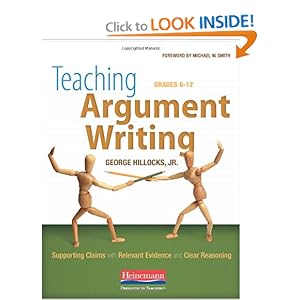
This blog post from a teacher directly integrates an argument writing text by George Hillocks, Jr., Teaching Argument Writing, Grades 6-12 (with a bonus handout!) as a strategy for students to attack math word problems

16 April 2014

Should Your Students Be Practicing Typing for CCSS Assessments?


The Problem Ahead
There is a lot of concern among a lot of elementary teachers I know about the younger kiddos' proficiency with computer skills necessary for completing Missouri's version of the Smarter Balanced Assessment field test later this spring.

I understand the concern. When we're trying to eek out every accreditation point we can, it would be a SHAME to miss the mark because our kiddos knew what they needed to know, but where unable to communicate their knowledge because they were uncomfortable with the interface, typing skills, or mouse skills that will be required of them on this web-based assessment.

So, to address the concerns, many of them have been discussing using the labs in their buildings to have kids practice typing on software or web-based typing games. There's irony here, right? Not only are we teaching to the test now, we're teaching to the skills for regurgitating the skills on the test. Forgive me if I'm out of place here - I have only a small amount of experience with elementary from my year subbing in 2007 and 2008 - but this doesn't seem rational. Elementary teachers are pulled a myriad of directions every day trying to fit in writer's workshops, reader's workshops, social studies, science, math, and specials, and already don't have enough time for their content, but we're going to advise they take time from content and relationship for kids to play typing games?

We don't need them to become home-row drones that crank out 80 wpm. We need kids that are comfortable typing real documents. We need kids that can take something they may have written down on a piece of paper and transfer it to a text-box in the testing environment. We need kids that know how to type out some math as simple even as 8+7=15 without searching for each symbol.

Are There Relevant Activities Can You Do To Practice Typing? (when all you have is lab)
Here's a quick list (this is one of things that are great for searching on Pinterest)

  1. Keep writer's workshop drafts or journals in a notebook, have students choose their best to type on lab day and publish to share online
  2. Pair students on a collaborative doc tool and take turns writing passages of a story
  3. Practice spelling words
  4. Choose an article or nonfiction passage in one of your content areas and write summary statements per paragraph.
  5. After a science experiment in the classroom, students write up a "report" detailing their hypothesis, method, results, and conclusion.
  6. Have students choose a recent leveled book they've read and write a review on Amazon or this site from Scholastic.
  7. Create a multiplication or factors table for personal use during math time.
Conclusion
Are "computer skills" important for our students? Absolutely. However, if we think about preparing them for CCSS assessments as another extra task, we miss the point. Skills practice and refinement can and should be integrated with content-specific activities - your students will be better equipped to transfer their skills when they've gained them within a "real" context.

22 February 2014

Blogging Options for Teachers


I offered a challenge to the Web 2.0 Resources course I’m teaching for teachers in my school district – start a blog and reflect on your journey.
Ar least one of them must have been interested, because just a heartbeat after I issued my challenge “homework,” they asked, “Which website would you suggest?”
Touché. I had not considered that question. :)
So, without further ado, here’s my take on leading blogging platforms for teachers who want to share their craft – both successes and failures.
Note: While I enjoy it as a blogging platform, i did not include Tumblr in this list for teachers because we block it on the filters in my district (and i assume thats true for others).
BLOGGER
Blogger is (for now) my platform of choice.
Pros:
  • Integrated with Google, so it plays well with images you may have saved in other Google services, and can track your user stats easily with Google analytic tools.
  • TONS of options for customizing your layout or design, whether you know HTML and CSS or not.
  • mobile user focused layouts available. (You dont want your blog to be a pain for someone to navigate on their phone or smaller tablet
  • One-step sharing to Google+ helps get your post in front of an audience
  • Add widgets to your site with javascript. My Twitter feed is right over there on the right (if you’re reading this on Blogger)
Cons:
  • It’s a little difficult to find other teachers to follow within Blogger, which would also mean its a little difficult of other teachers to find YOU.
  • How many people “follow” my blog? (Subscribe to it such that when I update they receive an email, or it is fed to them through an RSS feed) I have no idea. This is hard to track in Blogger.
  • The only thing you can do on the iOS app is publish basic text and plug in photos. Not even any embedded HTML, so I really must ALWAYS write from my desktop or macbook.
WORDPRESS
While Blogger is my main squeeze, I cheat on it with WordPress because my wife uses it and sometimes I get blog tool envy.
Pros:
  • Reblogging. Did you find another blog post that is inspiring you to add commentary on or write your own on the subject? Reblogging puts that post along with your own text onto your blog. I think it builds community as other teachers share ideas, and it can drive a little more traffic to your own blog.
  • Following other blogs and finding your subscribers. WordPress has a reader built within it, which makes it easier to find other teachers, read other teachers, and find out who else is subscribing to you. This is what I most wish Blogger had.
  • Built-in user stats are more easy to use AND more extensive than Blogger. All or most of the data on the stats page of WordPress is available for Blogger bloggers if you also use Google Analytics, but who wants ONE MORE TOOL to check? I mean, you just added blogging to your list, right? :)
  • AMAZING iOS app
Cons:
  • Short on HTML and CSS customization. If you use the free version, you’re pretty stuck in the official WordPress templates
  • No custom widgets on the free version. (although there are some official WordPress widgets you can add)
EDUBLOGS
Edublogs has been around since 2005, so they certainly have the most experience with teacher and student blogs, and (in my opinion) have a lot of polish on the product. The platform is built on the bones WordPress publishes for companies, so operationally, it quite similar.
Pros:
  • COMMUNITY. Edublogs has a tab on their home page that takes you to a page organizing the community of edubloggers according to interest. Whereas I can do a search on WordPress.com and find many relevant teacher blogs to my interest, the Edublogs community page lists TOP blogs in that category. I see value in that because I don’t want to sift through potential junk.
    20140222-212409.jpg
  • Professional development. New to blogging? Take the “Edublogs Teacher Challenge.” It’s like a self-directed online course in blogging.
  • Mobile-friendly. I set up everything on my iPad.
Cons:
  • COST. Unless you pay $7.95 a month to get a pro account, you might as well have a WordPress.com or Blogger account. The power of Edublogs is in organizing all of your students’ blogs in one place and having control over who sees your posts and their posts, but you have none of that power with a free account.
KIDBLOG
The favorite thing about Kidblogs is how they market themselves. Essentially its, “Do everything you would on Edublogs, but for free.” There’s a chart on this page spelling all of that out.
Pros:
  • WordPress platform. Just like Edublogs, its built on WordPress’ product for hosting your own blogs, so the platform is easy to use and manage.
  • TONS of privacy settings. If you’re writing only for your class and your students’ parents, you can completely lockdown privacy by making your blog visible only to individuals who login from that class. The younger your students are, the more important this is, obviously.
  • Have your students blog and reflect with you. (For free this time, as opposed to Edublogs). Set up accounts and blogs for your students and manage their posts, comments, and privacy setttings.
  • There’s an iOS app, but it’s slow to be updated.
Cons:
  • It’s called KIDblogs. My high schoolers are always super sensitive to being “grown,” so I don’t know how jazzed they would be with sharing their super thoughtful reflection from their Kidblogs account.
  • Just like WordPress, a little short on the customization of the layout and design. That’s a con for me as a teacher that likes that, but it might actually be a positive for kids who are going to spend all of their time on the layout instead of writing.
    20140222-214249.jpg
SUMMARY
Whichever tool you choose is up to your needs. Giving each of these an honest assessment, I would feel comfortable using any of them, with a slight reservation with the kidblogs name. I’m a grown man, for crying out loud. :)
If you’re going to write WITH your students, I would strongly suggest Kidblogs, but I would at least peek over at the Edublogs community and professional development pages. I know I will.

13 January 2014

Podcasts in the Classroom for Relevant, Subject-Specific Content


If you only use your smartphone or tablet for playing games, taking pictures, social media, listening to music, or ::gasp:: communicating, you're missing out on great opportunities to immerse yourself in easily-digestible academic content that will probably make you smarter (and more interesting) :)

If you've ever listened to an audiobook, you understand how convenient podcasts can be in "reading" while you perform other tasks, like driving. My wife and I got hooked on Freakonomics one road trip when I checked out the authors' second audio book, Super Freakonomics, from our local library.

The two Freakonomics books, documentary film and the companion blog and podcast is not only about economics. While co-author Steven D Levitt of the University of Chicago IS an accomplished economist, I'd more likely describe Freakonomics as an exploration in the use of data and statistical methodology to study or improve anything.

The consequence of the wide-range of subjects addressed in the Freakonomics podcasts is that you can quite easily find one that piques your particular niche of interest. Here's a list of topics just from the last few months:

Are We Ready to Legalize Marijuana?
What is the Best Exercise?
The Pope's Recent Critique on Capitalism
Are Gay Men Really Rich?
Fighting Poverty with Actual Evidence
For NBA Hopefuls, Zip Code Matters
Who Runs the Internet?

They've also done work on the NFL and sumo-wrestling. :)
But Freakonomics is just the tip of the iceberg! Here's a list of 9 more educational podcasts to share with your students for reflection, introduction, or enrichment

TEDTalks Audio - TED conferences are places to share recent research or discoveries in short, energetic presentations, usually shorter than 20 minutes.
Radiolab - Natural Sciences - Radiolab is a show about curiosity. Where sound illuminates ideas, and the boundaries blur between science, philosophy, and human experience.
CNN Student News
GrammarGirl - Quick and Dirty Tips
Coffee Break Spanish and French
The Math Dude
60 Second Civics
Stuff You Missed in History Class


I'll be using a Freakonomics podcast that I heard over Thanksgiving Break with my AP Stats class to introduce their capstone project for the semester- developing a statistical inference experiment to answer any question they want. I'm hoping by broadening their statistical exposure beyond politics and sports will help them be more creative in their experiment-dreaming.

The students will be assigned the Poverty podcast linked above and given several question prompts to respond to - about half of which are about the actual content of the podcast and half more about reflecting on possible topics for the capstone project in May.

Here's a link to the assignment.
"The Relevance of Statistical Work"


01 January 2014

The Daily 5 in Grades 6-12: Making It Work

This post is the 1st in a series devoted to adapting the literacy tenets of "The Daily 5" to a secondary classroom with 50 minute periods. You can catch the whole series here.


"A lot of these apps would be great for getting your Daily 5 work in..."

I was at an Education Technology Conference last February watching +Kathy Knutson and +Holly Camacaro present on their use of iOS apps in their Kindergarten and 3rd graders respectively, and Kathy paused for a moment to see if she needed to briefly summarize Daily 5 for anyone.

In the room full of elementary teachers, I was apparently the only one that raised my hand. No problem, I've got Google. A very easy search on Google for "daily 5" gets you to the "The Daily Cafe," where you find out that Daily 5 is a literacy framework with 5 tenets:
  1. Read to Self 
  2. Work on Writing 
  3. Read to Someone 
  4. Listen to Reading 
  5. Word Work 
Exploring even just the Daily 5 website, it quickly becomes clear it is written to elementary teachers with time in their day to go through extended centers - something not feasible for me in a 50 minute class period. Because I work with elementary teachers on the district EdTech Team, I filed it away as useful for perspective, but otherwise ignored it.

When we returned to school in August, we were told that one of the goals for the year was a strategic literacy initiative, and that our main tool would be called "Daily 5" - every student reading 5 minutes a day in every class. While that could look like one of the 5 tenets listed above, it felt like an irrelevant add-on to me, so using what I know from my elementary friends, I decided to take one of the 5 "centers" and choose to do ONE for that class period.

Focusing on ONE of the "Daily 5" for my 50 minute period instead of tacking a sustained reading time to the end or beginning of the period provides several instructional advantages:
  • I can integrate the literacy work into what I would be doing that day anyway 
  • I can do "Daily 5" during any point of the period. Some days it is my lesson starter, other times it is the meat of instruction, and still others, it serves as a summary/assessment reflection piece at the end of the period. 
  • Students see an integration of literacy in their math curriculum instead of just reading in their math class(room). 
  • I do not make a point to hit every "5" every week, but I usually get at least three, so students are exposed to diverse literacy activities beyond passive reading. 
  • Because literacy is not planned for as an add-on, its effects are more likely to endure and I am more likely to be persistent and consistent in its integration. 

I plan to go into more depth on my literacy and technology efforts as my own Daily 5 presentation with +Abby Erwin at this year's METC conference nears, but just to get you started, here are a few activities I use pretty regularly.

I keep a cheat-sheet taped to the chalkboard next to my desk for easy reference while I'm planning - feel free to print this one!

07 October 2013

Writing in Math: Modeling is Powerful


My students encounter writing most in my AP Statistics class. Because of the responsibility to my students to prepare them for an AP exam that will require them to justify the statistical tests they conduct, the conclusions they make, and the observations they draw from graphs, data sets, or computer outputs, I have no choice but to engage them in writing tasks.

Students will not learn to write technically on their own. It's unnatural. It's "hard."
For the majority of my students, AP Statistics is their first exposure to sustained, technical, and descriptive writing. For the most part they've had short answer responses on some quizzes in other courses that will require them to explain "why" they think they're answer is reasonable, or how they came to their answer, but I find myself stretching and pulling all of 1st quarter to get these kids to write more than a sentence per prompt question. 

Consider the following histogram of a roughly symmetric, normal-ish distribution (if I'm losing you there, just know that this bar graph should be symmetric with a high peak in the center and long tails to both positive and negative infinity):

A pretty common prompt in the section where normal curves are introduced would ask something like, "Describe the shape of the distribution." Students usually feel pretty good about themselves if they remember to point out that its symmetric, and has a single peak. If they're getting frisky, they'll mention the tails off to the left and right, and point out the because the distribution is not skewed (with the data clumped in the right or left with a long tail to either side), that we know the mean and median would be roughly value, in the middle of that peak. 

I've come to expect these habits early in the year, so I lean heavy on giving positive feedback for effort (they wrote something), and always give a more specific example of how I would have refined what they said, or I read from my solution manual (sometimes even correcting the manual if I think the manual could have been more specific).

Students cannot know good technical writing without reading technical writing. 
Ironically, I think your textbook is a good place to start, because every section has passages you can easily pull that attempt to succinctly explain vocabulary or walk students through a procedure.

You hope there comes a time in every student's educational career where they stop filling their writing with flowery words that don't mean anything; that they would get to the point, especially in technical writing. However, the pendulum soon swings the other way and students write much less than they should, forcing the reader to assume much of the knowledge the student should be demonstrating.

To refer to the histogram again, I think a student given a prompt of, "Describe the histogram," or "Describe the characteristics of this data set" that had not been introduced to statistical terminology would probably write too much, and still not relay the point about symmetry and the placement of the mean/median. "There are 12 bars on the graph. The first one starts and -3 and goes up a little bit past 0.0..."

I've written all of this so I could share how embarrassingly inspired I was reading this report of a recent Pew Research Survey on the Affordable Care Act, and the role of Republicans vs. the President in the shutdown.

The writer of the report spent several paragraphs describing their methods, the lengths the survey designers took to eliminate response bias from the participants, and examining the bias they were unable to eliminate through their methods. It's just a lot of good, descriptive, writing that will be great for the Experiment Design chapter in the AP Stats curriculum. 
"The analysis in this report is based on telephone interviews conducted October 3-6, 2013, among a national sample of 1,000 adults 18 years of age or older living in the continental United States (500 respondents were interviewed on a landline telephone, and 500 were interviewed on a cell phone, including 250 who had no landline telephone). The survey was conducted by interviewers at Princeton Data Source under the direction of Princeton Survey Research Associates International. A combination of landline and cell phone random digit dial samples were used; both samples were provided by Survey Sampling International. Interviews were conducted in English. Respondents in the landline sample were selected by randomly asking for the youngest adult male or female who is now at home. Interviews in the cell sample were conducted with the person who answered the phone, if that person was an adult 18 years of age or older. For detailed information about our survey methodology, see: http://people-press.org/methodology/. 
The combined landline and cell phone sample are weighted using an iterative technique that matches gender, age, education, race, Hispanic origin and region to parameters from the 2011 Census Bureau’s American Community Survey and population density to parameters from the Decennial Census. The sample also is weighted to match current patterns of telephone status, based on extrapolations from the 2012 National Health Interview Survey. The weighting procedure also accounts for the fact that respondents with both landline and cell phones have a greater probability of being included in the combined sample and adjusts for household size among respondents with a landline phone. Sampling errors and statistical tests of significance take into account the effect of weighting. The following table shows the unweighted sample sizes and the error attributable to sampling that would be expected at the 95% level of confidence for different groups in the survey: 
 
Sample sizes and sampling errors for other subgroups are available upon request.
In addition to sampling error, one should bear in mind that question wording and practical difficulties in conducting surveys can introduce error or bias into the findings of opinion polls.
"

11 August 2013

Teaching Argument Writing...for Preschoolers! (and Anyone Else)


I had the pleasure of attending a two day training over the summer with the Gateway Writing Project about teaching argument writing and how we can use it to support the need for evidence-based writing in the Common Core ELA and math standards. 


  • CCSS.ELA-Literacy.W.9-10.1 Write arguments to support claims in an analysis of substantive topics or texts, using valid reasoning and relevant and sufficient evidence.
  • CCSS.ELA-Literacy.W.6.1 Write arguments to support claims with clear reasons and relevant evidence.
  • CCSS.Math.Practice.MP3 Construct viable arguments and critique the reasoning of others.


Although the requirements for thinking abstractly and putting together objective, argument pieces are not introduced until grade 6, the foundation of vocabulary, thinking and process of gathering evidence, making claims, and evaluating warrants could ideally begin in earlier grades as students write explanatory pieces.

Before I get ahead of myself, let me quickly define for you a warrant and a claim as from this book by George Hillocks, Jr., Teaching Argument Writing, Grades 6-12.


"Warrants may be common sense rules that people generally accept as true, laws, scientific principles or studies, and thoughtfully argued definitions." (Hillocks, pg xxiii)
Claims are the statement or value you are trying to prove the evidence supports. (Hillocks, pg xix)


But What Does That Have To Do With Teaching Preschoolers?

I had the pleasure of spending so much time watching my children, 3 years, 8 months, and 2 years learn and play this summer, so most of what I'm processing as a teacher right now is through my lens as their teacher this summer. Also, if you can communicate an idea to a 3 year old, you know you're set for the intended audience. :)

Of course, I wasn't sitting down with my daughter this evening and discussing vocabulary with her - we weren't even writing anything. Our exposure to argument and reasoning was during story time before bed.


Breaking It Down

We read Pinkalicious: The Princess of Pink Slumber Party, which recently came from the library.


The plot of this story doesn't really matter. You just need to know that Pinkalicious has a slumber party, and one of the friends ends up having a fear of falling asleep at another house.

Pinkalicious gets the girl to imagine various sounds and smells around the house are from a happy guardian dragon.


We met the dragon and I thought, "Interesting time to test some reasoning," so, very naturally, in my best inquisitive voice, I asked Lucy, 
"Do you think this is a mean dragon, or a nice dragon?"
"It's nice."
"How do you know?"
"Because its smiling!"  ::she points to the dragons mouth::
"Ah, and so usually when people are nice, they smile."
We continue on the story, and I'm happy to report, the little girl has no problem falling asleep.


Connecting to Terminology

Lucy did not produce an entire argument on her own, of course, but would you even expect that of all your middle schoolers or 9th graders? With some scaffolding questions, she was able to show the bones of some basic reasoning, however.

Claim: In response to my leading question, Lucy's claim is that This is a nice dragon.
Evidence: When I asked Lucy how she knew, she easily pointed out that the dragon was smiling.

In the experience of my own classroom with something like classifying functions, the process has been the same. I might ask, "Is this a quadratic function," to which a student at first may only respond, "Yes," but after I ask, "How do you know," she will often be able to point out a defining characteristic from a table, graph, or equation.

Warrant: As defined by Hillocks, a warrant is often something generally known. Kids learn quickly that they can usually trust adults or other kids that are smiling. Lucy left this off of her "argument," but warrants are the bones that support claims.

While warrants in an English or Social Studies class may be a little more subjective, I think STEM subjects generally have a stronger leg to stand on when picking out and using warrants. I explained warrants to a colleague today in the math office as being the properties and laws our students (often) write down and (rarely ever) use in their problem solving.


In the Classroom

The first several times you attempt argument writing with your students, I think it may end up looking and feeling a lot like my conversation with Lucy. I think that has to be okay.  Use guiding questions in pre-reading. Support them with definitions and clarify/refine their usage of warrant/ claim/ counterclaim. Restate their conclusion so they can have a chance to analyze if it "sounds" right once they've heard it outside of their own head or from their paper.