Showing posts with label learning. Show all posts

29 April 2016

Is "Makerspace" Another Learning Silo?


The principles of design, engineering and iteration that students get to practice in maker environments is invaluable - I get it.

What worries me some is I sense in the rush to get grant money for the next big thing, schools are rushing to put in makerspaces like they're just another elective that the creative students can go to, but might not be for everyone.

When we install the MAKERSPACE room or turn our libraries into them (which I'm more okay with, because it blends information space with design space with collaborative space), don't we run the risk of just building another silo in which kids compartmentalize their experiences? On the flip-side, if teachers know that kids will be able to do _____ in "makerspace," doesn't that give an escape clause to anyone who wants to maintain a more traditional lecture-practice-test-repeat classroom?

I love the way my friend +Manuel Herrera is developing his space at Affton High School, "Room 15" because while it has maker elements included, it's still a learning space first. Making is something that happens alongside other work, and students and staff and come in and try on the room for activities unrelated to "making" at all.

Because I love to see interdisciplinary approaches WHENEVER and WHEREVER possible, I would much sooner advocate a school invest in a few pimped out maker-carts if they're looking to buy and put together a bunch of maker-stuff. It loses the design-collaborative space aspect that makes Room 15 so special, but gives many more opportunities for teachers to practice making and engaging in design challenges.


What do you think - if you have to choose how to start, is it better to focus on carts and spread the opportunity in your school, or have a dedicated "makerspace" that serves as a model space for students AND teachers to learn about design?

08 April 2016

Should We Have Math 7th Hour?

I have 3 Algebra Strategies classes this semester - 2 in the morning and 1 in our last class of the school day.

These classes' assignments are all differentiated according to students' skill levels and all the exercises are individually generated using Renaissance Learning's Accelerated Math. I love doing these classes because I get a ton of time to work individually with students and its a fantastic opportunity for students to catch or get ahead in their math skills if they take advantage of it.

Because everything is differentiated and individualized, I've seen students' growth have a correlation to their capacity to monitor their own on-task behavior and persevere through assignments.

I'm sure I don't have to tell any educator this, but the last hour of the day is difficult for students' attention in any course. That physical need to blow off steam and relax after a long day of sitting in chairs is not a recipe for success in a program that requires that self-monitored attention.

Take a look at these box plots from my 3 classes measuring the spread of the students' "student growth percentile," a metric Renaissance Learning includes in their reports of student performance on their benchmark "STAR" tests that measures a student's age AND prior performance against a peer group.

According to training material from Renaissance Learning, "ideal, typical growth" for a student will be anywhere between 35 and 75 percentile SGP. My first two classes' median SGP are at the top of that range! Then inexplicably, a similar student population using the exact same program in my 7th hour has a median SGP of 38.

Could there be anything else at play here besides the 7th hour effect?

22 May 2015

Can Your Students Hide?


The schools that we need demand different. They need to support the open and transparent world that is exploding around education. This begins with pushing students into the center of the ring. In the center, there is no room to hide. It is a place of full engagement where real questions about real issues are being addressed with real solutions that will impact real people. - Dr. Robert Dillon, @ideaguy42

I was reading the preface in my friend Bob Dillon's first book tonight and was struck quickly by this paragraph. 

I've attempted several different ways to make this school year we're wrapping up next year the most student-centered, project/problem-based, and driven by student collaboration and conversation. What I found out quickly (and continued to observe) was that its been more evident than any of my 7 years teaching this year what students can or cannot do, which students are putting in the work, and which students are waiting on me to do most of the work of learning.

I think its safe to say I've had the most real conversations this year and talked about more "other" things beyond math (in the midst of projects) this year in the midst of communicating rationales and learning objectives and developing hooks for my students. 

I think its also safe to say I've had the most cries this semester that I "never teach." That "[the students] don't do anything in this class." That "[some students] haven't learned anything in here." A lot of the time a kid makes these complaints about not doing anything or not learning anything, that kid is more right than he or she is wrong. Particularly if their idea of "learning" is that I go through examples at my SMARTboard, give them a worksheet, and then expect them to regurgitate the process on a quiz a few days later. Things get messier when you try to push students to the center because things get less predictable. The importance of relationship (or lack thereof) in learning becomes more evident.

When you can't hide, you feel uncomfortable if you're used to living in the shadows, right? You're vulnerable. Your weaknesses are exposed and you can only survive on your strengths for so long. Coming out of hiding and thriving is only something that happens if you are in an environment safe for risk and vulnerability?

How do you model this?
How do you get your students to buy-in to change?

Even if students were not particularly successful in traditional lecture-homework-quiz-test/project classrooms, I've found they still might prefer that model because although they have more autonomy in a more student-driven classroom, they also have more responsibility (and accountability) for their learning. The more I've allowed my students to dictate what we do in class, the more I've seen this push-back from some of my students. 

This post has become one of those more-questions-than-answers type of discussions, which I guess is reflective of where I'm at with it practically. I WANT a more student-centered classroom, my students NEED a more relevant, responsive classroom, I know how learning like this looks for MYSELF, but I'm got several challenges I don't yet know how to address in my CLASSROOM.

What do you know, readers? Can students hide in your room? What's your student-centered classroom go-to strategy?

08 February 2015

Valuing Focus vs Creativity

Which should we value more in education? Should we have to choose between the two?
Have you ever seen this happen in your classroom? I remember lots of "he's not been on his meds," "they're in the process of changing meds," and "we're hoping the meds will help," conversations with parents and special ed case managers over the years that didn't always end have subsequent results I was hoping for that student.

It's hard to argue that attempting to control a child's hyperactivity or attention deficits is ALWAYS good or ALWAYS bad. While we see Calvin lose his imagination in the frames above, maybe we see his perseverance in problem solving increased. Perhaps because his brain is tuning out some inputs, he finally FINISHES well on a project and what may have otherwise been a serviceable B or C becomes an exceptional talk-about-it-to-everyone-you-know type project.

Are we putting Calvin and his parents in an impossible situation in the first place? Could Calvin's classroom teacher put more of an emphasis on learning through play and discovery? Could his teacher considered other ways for him to demonstrate his learning? (Unless report writing literally was the skill to be assessed - I believe we do still have a responsibility to produce capable writers, even as we provide alternative assessments.).  What happened to Calvin's work in art class after the meds? How elaborately planned and detailed were his creative freewrites?

What are you doing to welcome Calvin AND Hobbes in your classroom? Do you have any success stories from a time you may have welcomed the chaos of ideas that a non-medicated student brought to the classroom? 

29 November 2014

2-Way Mirror: What Dance Class Taught Me About "Each As My Own"

We had a motto (mission? slogan? value?) in my district 7 years ago when I began teaching that went something like, "Treating Every Student Like You Would Your Own." That's a great principle to teach by, but it only really works if whoever applies it HAS CHILDREN. Before (and even when they were still infants) I did a lot of things in the classroom that weren't necessarily bad, but that I would do differently now that I'm seeing my little ones grow as learners.

A couple of years ago, I got take my daughter alone to a make-up dance class during the week and watch through the two-way mirror. The experience was thrilling and nerve-racking, to watch your kid doing something they love, but not really getting to enjoy it with them. Obviously, I don't have a two-way in my high school math classroom, but how would that change my behaviors if I did? How would that change my parent interactions?

It BROKE MY HEART to sit there and watch Lucy struggle with something the other kids were having more success with (she's still working on the formal aspect of dance over improv, and this make-up class has older girls in it), but there were two things I see parents do that I did not feel because I watched it happen:

1. I didn't blame the teacher. We know that parents know their kids best, but that should also mean they know where their child struggles. I made a mental list of things I saw Lucy needs to work on.

2. I didn't blame Lucy or myself. I could SEE her effort, so I know that she needs more practice, and more feedback. We've all heard "I was never good at _______" be used as a reason for a child's lack of interest or success in math class. I've never had formal dance training, but I know watching that class that I want my daughter to feel good about herself as a dance student, so I'll do whatever I can to assist in that.

What the two-way mirror made me reflect about my own behaviors in the classroom is how much time I spend redirecting one student, again and again, at the expense of many others? Is that right, or not? How many chances does a kid deserve? (One of Lucy's go-to lines when she's in trouble for not obeying is, "Can I have just ONE. MORE. CHANCE?!")


I actually started the first draft of this post a year and a half ago. It was Lucy's first experience in a "classroom" and my first experience as a parent of a "student". The conclusion I would have made then was that, yes, sometimes we need to let a kid go so the bulk of the class can get a chance to learn what they need to know (In the case of the dance class, it was particular movements, in your math class, it might be solving quadratics). I think NCLB showed us that when our strength of our focus is on bringing up the very, very bottom, that rigor of instruction gets dragged down with it. 

A year and a half ago, I still wore my teacher goggles as a parent. I was disappointed Lucy wasn't keeping up, but I understood the dynamic on the other side of the mirror as the teacher repeatedly redirected her to stay on line, to listen, and to follow along. I felt more compassionate for those kids that struggle, and their parents that are doing the best that they can, but I can't say it was affecting my practice. 

This school year, my middle child, my oldest son, started pre-k in a special ed classroom at our school district's early childhood center. We've entered the world of IEPs, progress reports, and letters home in backpacks. My wife spent a day in his classroom a few weeks ago and said he spent at least a 1/3 of his time there blowing bubbles. There's a kid in his class that struggles using "safe hands" (hitting) and with general impulse control, so I'm sure that Landon gets to spend of lot of his time on choice time because he's a nice, generally compliant kid. He generally likes school, and when a lot of his time is spent blowing bubbles and eating goldfish (his speech therapist has been giving him one for each produced sound), its no wonder!

Here's what I get now about the students in my class, and their parents' expectations -
When you work out "each as my own" in your classroom, you realize that it doesn't work best for any kid for when you attempt to put all kids into a group. Some students and families are better adapting to it than others, but "getting by" is not the way that I want to remember any of my own children's experience. When I was on the parent side of the 2-way mirror, all I wanted was for Lucy to get all of her teacher's attention all of the time. No big deal. ;)

So how does that work practically?
We have the impossible task of giving each student as individual and appropriate an experience as we can. We have to go the distance for each kid as long as I would my own children. Even if my students' parents don't have time to call me or come chat with me at conferences, they still want the best for their child, so I owe that to them. 

18 September 2014

On Being An Expert

Think about anything you consider yourself an "expert" in - a skill related to your profession, a hobby, a category of trivia or knowledge. How did you become an "expert?" You probably have a certain acumen for learning new things related to your area of expertise, but ultimately, it came down to a decision you made at some point to seek and find knowledge about a topic. And then to do it again and again and again.

Talent is something you are more or less born with. Expertise is nurtured, coddled, and deliberately tended to so it will grow. You may have few talents, but anyone can develop expertise. It's a numbers and perseverance game.


That said, my district is in up to our knees in a software transition for every major information system we use. Every employee in the district is in effect relearning how to do their job this semester. Through a little bit of formal professional development and a whole lot more informal and self-directed, I've become the go-to guy for SIS tutorials, questions, and gripes.

The switch is affecting our students and families, too, because we don't have their access to online grades and attendance unlocked yet, so the school newspaper is working on a piece about it. I was approached by a student-reporter today for some quotes about SIS. 

I spent a lot of time crafting these responses, and I like 'em, so I decided to post them here, too. :)

STARGAZER: If you know, why was there a change from Edline to Tyler?

CHUCK BAKER: The way that SIS can manage and integrate the data we generate in our gradebooks and attendance with your student records is a leap from Edline. Our attendance software was from the 80s, our gradebook from the 90s... Data is KING in the 21st century, and SIS is going to make how we manage, manipulate and analyze our student data much easier.

SG: How will the affect students and their ability to view their grades easily like they did with Edline, and will students be able to access grades on Tyler like they did with Edline -- if yes, when?

CB: Right now, teachers must give students and parents print-outs or post grades on the wall of the classroom, which is what a teacher with more than 6 or 7 years of experience used to have to do anyway because it was the ONLY option. You know how things are a little bit sucky when an app is in beta? We're in beta with our SIS implementation still.The plan according to the district technology department is to open the student/parent portal (your side or SIS) for 2nd semester, but there's a chance it could be sooner.

Some elementary teachers were using NO form of electronic gradebook, so putting everything into SIS is a HUGE leap for them. We have to wait until the majority of teachers in the whole district have the gradebook figured out.

SG: Will there be any long-lasting affect of this switch during the current school year, if yes what will they be?

CB: I don't think you'll notice any long-lasting effects of this switch during the current year from the your teachers. The grade level offices are able to check attendance and discipline much quicker now, so they might be able to be more proactive in addressing patterns of absence or behavior before they are too late to fix. I think we might see more differences next year, when much more of the staff is very comfortable with the system.

SG: Have students complained to you about their inability to easily view their grades?

CB: My AP Stats students (my seniors) complained on like, the 2nd day of school, but my other students have been cool with the printouts I've been giving them. From my experience, giving students a piece of paper is sometimes more effective in focusing their attention away from the Snaps and notifications bombarding their devices. I find it in myself, too. I often will open my laptop or grab my iPad to do some actual work, but I get lost in social media or crushin' candy - if I need to leave the distraction of iPad, I do the work on paper first.

SG: What will be noticeably different from Edline?

CB: My favorite noticeable difference for students and parents to look forward to once your side of SIS is unlocked is that there will be much more information available to you in once place. Besides just grades, attendance will also be readily accessible, and teachers will be able to post any extra directions or links to web and/or multimedia content for a lesson right on the listing on the grade report. You would not have to specially ask for such and such handout that you need to complete missing or make-up work, or to find the link to your math teacher's video lesson.

SG: If you could chose a few of the positive affects of implementing this system, what would they be? The negatives?

CB: 
Positives:

  1. The parent/student side of SIS looks more user-friendly than the reports Edline gave you, and I like the idea of being able to provide lesson resources right there instead of uploading them to a different site that you have to access separately.
  2. Our various data sources integrate more easily - student attendance or behavior patterns can be caught, monitored, and addressed before they become larger problems.

Negatives:
  1. Online grades being inaccessible for now
  2. CHANGE. A lot of people really hate change, man.

16 March 2014

Choose Your Ed Tech Like a 500 Year Old Saint

Having a plan for the education technology you use in your classroom, school, or district must be the first thing you do when considering technology implementation.

You could do worse than designing your technology plan around the educational principles of a 500 year-old saint.

St. Ignatius and the Jesuit Educational Mission
Quick background for the Igna-ignorant like I was several months ago (with apologies to my Catholic friends who know more about this than I do).
"Ignatius of Loyola was a Spanish knight from a local Basque noble family, hermit, priest since 1537, and theologian, who founded the Society of Jesus (Jesuits) and, on 19 April 1541, became its first Superior General.[2] Ignatius emerged as a religious leader during the Counter-Reformation. Loyola's devotion to the Catholic Church was characterized by absolute obedience to the Pope.[3]" - from Wikipedia, "Ignatius of Loyola"
"The Ignatian pedagogical paradigm is a way of learning and a method of teaching taken from the Spiritual Exercises of Ignatius of Loyola.[1][2] It is based in St. Ignatius Loyola's Spiritual Exercises, and takes a holistic view of the world.[3]
The three main elements are Experience, Reflection, and Action. A pre-learning element, Context, and a post-learning element, Evaluation, are also necessary for the method's success, bringing the total to five elements. Ignatian pedagogy uses this dynamic five-step method along with an Ignatian vision of the human and the world to "accompany the learner in their growth and development."[4] 
The Ignatian pedagogical paradigm is also used in spiritual retreats and learning experiences as an active means of developing and questioning one's own conscience, as well as in making sound and conscientious decisions." from Wikipedia, "Ignatian Pedagogical Paradigm"
These 5 elements of the Ignatian pedagogical paradigm and the Jesuit motto, ad majorem dei gloriam ("to the greater glory of God"), serve as a educational framework for the numerous Jesuit sponsored high schools and universities in North America and around the world. (including St. Louis UniversitySt. Louis University High, and De Smet Jesuit High locally)

To the greater glory of God and the salvation of man

Wrapping Your Faith and Your Professional Life Together
Its been my experience teaching in public schools as a Christian that the further I want to make all of my choices in accordance with my mission to Jesus, the more fulfilled I feel, the more I can stand in the conviction of my choices, but also, the less some of my colleagues, students, and parents may understand where I'm coming from.

Being a teacher that's a Christian is about more than "being Jesus to my students" as the most honest, or most compassionate, or most just teacher in the school - its a challenge to make every pedagogical decision in light of you and your students as spiritual beings with imbued worth as beings created in the image of God. As just one example, being a standards-based grader is a great opportunity to silently craft a narrative of mercy, repentance, and redemption to your students. (The analogy falls apart when I think about grace - if our sins are really analogous to grades, we don't try and try again until we get it right, Jesus takes the failing grade for us and we're granted "mastery" through his sacrifice, but you get the point.)

A lot of money gets thrown at technology because it looks good, or because its the next lastest, greatest savior of education, but following Ignatian principles and reflecting on "to the greater Glory of God," we can be more sure of the stewardship and utility of our technology choices.

For more reading on the Ignatian Pedagogical Paradigm, this paper from the Jesuits, "Ignatian Pedagogy: A Practical Approach" was very helpful for me.

Using Technology to Enrich Your Students' Experience and Call to Action
How can education technology affect or serve each of Ignatian elements of education?

1. Context
Thinking about your students contextually should always be a consideration when evaluating a technology tool. Can my students use this? Would my students be willing to try this? When I was anti-flipping the classroom on the basis of home access for some of my students, I was sitting here in context.

2. Experience
When a lesson affects your students on more than a superficial level with little active engagment, the material is less likely to "stick" or to spur students to action to apply the knowledge. Integrating multimedia resources to affect senses, reaching out to professionals in the field of study with social media, creating discussion boards via Padlet, or creating a digital artifact to link to the lesson in the students' experience are just a few examples

3. Reflection
Ignatius and the Jesuits went against a "monastic" life of seclusion, which made reflection and solitude in the midst of mission of vital importance. We see times in Jesus' ministry where he left the crowds to be alone with the Apostles, and separated even further to be along in prayer.

Reflection in the Ignatian paradigm is the opportunity to look back on the experience and action of the day to find their worth and to seek what the Holy Spirit is doing next. Even if you're not a Christian, reflection is VITALLY important to teaching because it is the time when we see how we've done and what we have to do next. Reflection is when we sort out our perceptions from reality. Blogging is the only edtech application I see here, but really, why try to do more with it than that? :)

4. Action
The Jesuits were all about being on mission (some compare them to "Catholic Marines"), so the purpose of any learning experience is to compel the student to want to do something with what they've learned. Action is where you put into practice what convictions you found in reflection. This is an excellent opportunity to use technology to reach out to community leaders, upload a video to launch a viral campaign for a cause, or even use a 3D printer to make a product to meet someone's need.

5. Evaluation
How'd you do? What your action effective? Evaluation is the last element in the Ignatian cycle because it then affects the next lesson's context. As far as technology goes, here's another chance for students to blog as self-assessment, use adaptive software tools like Study Island, Manga High or Renaissance Learning for testing, send students a Google Form to fill out, or depending on the product they created in action, using site analytics or view counts as a real-life metric to their success.
YouTube Video Analytics of my most popular upload
"What's in it for me?"
As I mentioned earlier, once I started researching St. Ignatius' educational philosophies and how they fit in with the Jesuit mission for education, I found a lot of clarity in what the Holy Spirit had begun in me several months ago as far as what it means to be a teacher that's a Christian. I have always believed that whatever technology we use in schools should be in service to the learning, but it was harder to go further with that - "and what, exactly, beyond "math," do I want the kids to be learning?"

I felt a little embarrassed at "discovering" educational principles that teachers have been using in my own cities for nearly 200 years, but its been a refreshing response for me to the subjective, everyone's-truth-is-good-for-them attitudes that often prevail in education.

01 March 2014

Chicken or the Egg - Whose Learning Should Schools Prioritize?


The topic for Thursday night's #moedchat was "Out of the Box PD". I guess  the first question was my favorite, because I'm still thinking about it.


MY RESPONSE:


I didn't get the feeling that it was a very popular answer - maybe only because the focus of Thursday's chat was on TEACHER learning - but the more I reflect on it, the stronger I'm convicted. Wrapping it as a chicken/egg paradigm instead of front burner/back burner makes it a slightly different question, but the principle remains.


Student learning should be the primary focus of a school or distict over teacher PD because teacher learning would have to be a part of the discussion to serve that goal.


What happens when teacher learning comes first? Reflecting on my own career gives me a few things to consider.


1. Saying the right thing and having an instructional plan that LOOKS good takes precedence over evidence and results. 


We can have high-quality PD and high-five each other for the great conversations we have at edcamps, other conferences, or on Twitter chats, but there's a big step between knowing best practice, attempting best practice, and ACHIEVING best practice. In my own experience, when MY learning is most important, its tempting to blame anything that is unsuccessful in my classroom on various student factors.


"They didn't try hard enough."

"They didn't listen to my directions."


2. PD that does not focus first on the impact of a strategy or tool on students serves only the people in the room.


I am not a fan of "cool tool" sessions at conferences or PD trainings that focus on one particular tool, because in my own experience, my excitement to squeeze that tool into my own classroom sometimes results in a negative impact on learning as students hurdle the tech to learn the content or demonstrate their learning. If "how will my students use this" or "what challenges will my students face" is the first question, we risk complicating an environment that is already difficult to navigate for high-needs students.


The first semester I had iPads in my classroom, I tried giving a final exam on the Socrative "clicker" app. From my perspective, this was a slam dunk. My students had already used the app several times, so I knew they liked it, and while you could not put images into your Socrative quizzes at that point in time, I had gotten around it by printing copies of the exam with Socrative setup as a bubblesheet. What I thought was the big advantage for me and the kids was that Socrative was going to score their responses as they worked, making the feedback immediate - they would not be stressing for hours to find out how they did on the final. There was only ONE problem - Socrative forces the students to work linearly through the exam, so anyone that would normally  skip around and do the work they were most comfortable with first could not. On top of that, if a student accidentally pressed a response different than what they wanted, there was no way to go back and change it. Bottom line: for as much added benefit as Socrative provided with its immediate results (and easing my grading burden) the times kids were penalized for an errant finger resulted in a net impact of ZERO at best.


3.  Focusing on teachers' learning needs FIRST ignore the needs of the students in their context.


Instructional design 101 demands that before you prepare any instruction (or in this case, provide training for teachers to better teach the students), you conduct a needs assessment to meet the students where they are culturally, and what they bring to you in prior knowledge.


The students' learning must come first because they are the school variable that is always changing! Yes, there are circumstances for which meeting a set of students will require more training for a teacher, but that is in response to the student context.


What do you think? Should we prioritize teacher learning or student learning?

26 January 2014

Leapfrog Learning Path for iOS Answers the Question: "What Do I Do With My Kid?"

Increasing fathers' investment and proactivity (including my own) in their children's learning is on my mind this week.
I'm thinking of fathers in particular as I write this, but the experience is probably true of most mothers, as well, unless you have an education degree relating exactly to the ages of your children. How often do you think to yourself...

  • Is my kid bright, on target, or a little behind?
  • Is he supposed to be able to do that yet?
  • Is it normal that he isn't ________ yet?
  • What can I be doing to help my kid learn?

I trust that my wife has a better handle on these questions than most, and the support we get from Parents as Teachers, and my son's speech and occupational therapist fills in most of the gaps for her, but when I get home at the end of my day teaching teenagers, I often feel at a loss for what I need to be doing with my own children, ages 4, 2, and infant.


I'm trying to support her efforts as we homeschool preschool and give my kids quality/quantity time in the evening, but when my mind goes to "educational" activities, I often get stuck. I don't think the culture helps parents much on this topic beyond, "Read a book." Got that one covered, guys.

So, to the busy parent that still wants to direct their children's learning, I offer the Leapfrog Learning Path app for iOS.

If you have a LeapFrog Learning Pad, Leapster, or Tag Reader at your house, you probably already have a LeapFrog account that has been tracking your children through the LeapFrog Connect software you use to load content to the devices.

Here's what I love about the Learning Path app:

1. Age-appropriate activity ideas. 
The what's new tab highlights activities, tips, and printables that are age appropriate and feature the LeapFrog characters your kids are already familiar with. What should I do today with the kids?" gets answered on this page. Play a game, color a page together, read a book, etc.
This Pinterest/Google+ style board makes you feel right at home.
Yep, even for babies.

2. Learning Goals/Targets for Each Age Range
If you're in Parents as Teachers or an Early Ed program, you'll get a lot of this information from your child's teacher, but at least for us, it's a paper handout she brings along, and then, what? Am I supposed to file that away in a binder or something? It has enough competition on the fridge from magnetic letters and art projects. Informational paper doesn't last long around here.


3. Strategic Tools and Interventions
Different kids develop different skills at different rates. We all know that. But there's always at least a kernel in the back of your mind wondering what else you can be doing to try and get them ahead/catch them up.

I told the app that my son was "not yet" there on one of the goals listed for 2 year olds, and it gave me a strategy to try myself, and a (surprise!) LeapFrog branded toy to support my efforts.


Is this ultimately a marketing tool is get you to spend more money on LeapFrog products? Probably. But a friend made an interesting point about companies and profits last week - if the company provides me with a service that I really enjoy and am willing to pay for to use it, are they "evil" for profiting from the exchange?

Take LeapFrog Learning Path for what it can be for you, the involved (or seeking to be involved) parent-educator: a tool to assess your child's growth, resource for activities, and instructional guide for how best to integrate all of those LeapFrog toys you're buying anyway.


24 January 2014

Strategies for Solving Linear Equations

Getting ALL of your students proficient at solving linear equations is the Holy Grail of any Algebra teacher. Just about every PLC team I've been on has attempted to re-tackle it as an (in-achievable?) SMART goal.

SMART goal setting season is upon us once again in these parts, and the early formative data from our Applied Math (after Geometry, before Algebra 2) students suggests that we MUST place an emphasis on solving equations with variables on both sides of the equation.

We're going to share the following strategies with our students:
Algebraic:
  • have students draw line through equal sign
  • distribute first to eliminate “( )”
  • combine like terms on left, combine like terms on right
  • eliminate the smaller coefficient term
  • backwards order of operations
  • write answer as “variable = number”
Verbal:
  • write out algebraic steps/thinking in words
With Multiple Fractions:
  • multiply every part by least common multiple of the denominator

Common enough, I know. What I'm really sharing with you is the posters I made to put up in our classroom. If you're going to do something you're feeling a little deja vu over, the least you can do is apply some of your creative juices to change your attitude. :) I made these images at PicMonkey using a combination of textures and text, and just used the Microsoft Picture Viewer on our PCs at school to print them on a full 8.5x11 sheet.


11 August 2013

Teaching Argument Writing...for Preschoolers! (and Anyone Else)


I had the pleasure of attending a two day training over the summer with the Gateway Writing Project about teaching argument writing and how we can use it to support the need for evidence-based writing in the Common Core ELA and math standards. 


  • CCSS.ELA-Literacy.W.9-10.1 Write arguments to support claims in an analysis of substantive topics or texts, using valid reasoning and relevant and sufficient evidence.
  • CCSS.ELA-Literacy.W.6.1 Write arguments to support claims with clear reasons and relevant evidence.
  • CCSS.Math.Practice.MP3 Construct viable arguments and critique the reasoning of others.


Although the requirements for thinking abstractly and putting together objective, argument pieces are not introduced until grade 6, the foundation of vocabulary, thinking and process of gathering evidence, making claims, and evaluating warrants could ideally begin in earlier grades as students write explanatory pieces.

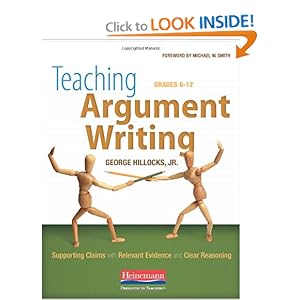
Before I get ahead of myself, let me quickly define for you a warrant and a claim as from this book by George Hillocks, Jr., Teaching Argument Writing, Grades 6-12.


"Warrants may be common sense rules that people generally accept as true, laws, scientific principles or studies, and thoughtfully argued definitions." (Hillocks, pg xxiii)
Claims are the statement or value you are trying to prove the evidence supports. (Hillocks, pg xix)


But What Does That Have To Do With Teaching Preschoolers?

I had the pleasure of spending so much time watching my children, 3 years, 8 months, and 2 years learn and play this summer, so most of what I'm processing as a teacher right now is through my lens as their teacher this summer. Also, if you can communicate an idea to a 3 year old, you know you're set for the intended audience. :)

Of course, I wasn't sitting down with my daughter this evening and discussing vocabulary with her - we weren't even writing anything. Our exposure to argument and reasoning was during story time before bed.


Breaking It Down

We read Pinkalicious: The Princess of Pink Slumber Party, which recently came from the library.


The plot of this story doesn't really matter. You just need to know that Pinkalicious has a slumber party, and one of the friends ends up having a fear of falling asleep at another house.

Pinkalicious gets the girl to imagine various sounds and smells around the house are from a happy guardian dragon.


We met the dragon and I thought, "Interesting time to test some reasoning," so, very naturally, in my best inquisitive voice, I asked Lucy, 
"Do you think this is a mean dragon, or a nice dragon?"
"It's nice."
"How do you know?"
"Because its smiling!"  ::she points to the dragons mouth::
"Ah, and so usually when people are nice, they smile."
We continue on the story, and I'm happy to report, the little girl has no problem falling asleep.


Connecting to Terminology

Lucy did not produce an entire argument on her own, of course, but would you even expect that of all your middle schoolers or 9th graders? With some scaffolding questions, she was able to show the bones of some basic reasoning, however.

Claim: In response to my leading question, Lucy's claim is that This is a nice dragon.
Evidence: When I asked Lucy how she knew, she easily pointed out that the dragon was smiling.

In the experience of my own classroom with something like classifying functions, the process has been the same. I might ask, "Is this a quadratic function," to which a student at first may only respond, "Yes," but after I ask, "How do you know," she will often be able to point out a defining characteristic from a table, graph, or equation.

Warrant: As defined by Hillocks, a warrant is often something generally known. Kids learn quickly that they can usually trust adults or other kids that are smiling. Lucy left this off of her "argument," but warrants are the bones that support claims.

While warrants in an English or Social Studies class may be a little more subjective, I think STEM subjects generally have a stronger leg to stand on when picking out and using warrants. I explained warrants to a colleague today in the math office as being the properties and laws our students (often) write down and (rarely ever) use in their problem solving.


In the Classroom

The first several times you attempt argument writing with your students, I think it may end up looking and feeling a lot like my conversation with Lucy. I think that has to be okay.  Use guiding questions in pre-reading. Support them with definitions and clarify/refine their usage of warrant/ claim/ counterclaim. Restate their conclusion so they can have a chance to analyze if it "sounds" right once they've heard it outside of their own head or from their paper.

14 May 2013

Jeff Bliss, Luddites, and Graduation Credits

Just happened upon this editorial from Trinidad and Tobago (you know, that country with the TieDye hockey sweaters in D2: The Mighty Ducks) calling for a new Luddite movement, and I'm not quick to disagree.

Wait, what? 

What's wrong?

This is a math and EDTECH blog. Why are you trying to champion the Luddites?

Do you KNOW about the Luddites, or do you only use the word synonymously for tech haters that make your job training and collaborating more difficult (depressing?)


Luddites were about quality. Is it in your life? Is it in your classroom?

All the championing of teacher-teller-offer Jeff Bliss this week has been largely about his passionate plea for impassioned teaching. I get it. The kids our one-size-fits most educational system hurts most are the ones who burned out once, realize they really want it for themselves, and then remember the whole reason they left in the first place. Sometimes school sucks.

Enter the machines to save the day! Flipped class! Online courses! Blogging! Differentiated objectives!

These are great strategies to turn the industrial system on its head - in the right hands. Online courses are wonderful for students who cannot participate in the time or space of the local traditional school. I love how the flipped class gives more time for peer discussion and productive struggle. Mastery systems that deliver differentiated objectives for individual students and groups lead students in goal setting, self pacing, and reward students who want to work ahead without punishing those that need more time.

None of these matter, however, if teachers and admin just go through the motions, gaming the new systems, getting kids through their new technology-enriched courses while patting themselves on the back with the credits they're rewarding. The teenager in front of you is more than willing to get his credits (that word has me thinking about arcade tokens, which is all I feel like they're worth sometimes) from "passing" that course. Are you REALLY helping them? I'm not sure.

Does Jeff Bliss just want to get through high school? I'm sure he wouldn't hate it, but is that what he deserves? Jeff Bliss wants to star on the movie about his life where he made the choice to return to school and in return found teachers who shared an kind of passion with him.

I don't think Jeff Bliss wants his math teacher to be his best friend, but I do think he wants to know his math teacher isn't counting down the minutes until he's out the door. It doesn't matter how shiny and differentiated our systems are if the teachers (even in online courses) are bland robots going through the motions.

Technology is great, but remember, you're also a craftsman.

05 April 2013

Student Blogging - In High School Math?!

Thursday's #moedchat was all about blogging in the classroom. And if the energy flowing in the chat was any indication, I'm apparently missing out on the fun.

The chat was moderated by the amazing +William Chamberlain (@wmchamberlain), a #comments4kids advocate, an EduBlog nominated writer many times over, and general tweep I trust. Beyond William, my sister, @JenBearden is in her second year blogging with her 5th graders at http://kidblog.org/MrsBeardensClass2012/

The archive is here. We had a great, enthusiastic chat about the purpose of kid blogging, defining the meaning and purpose of "authentic audience" and explored what makes kid blogging transition from another assignment to a transformative experience. A lot of good experiences were shared, and I know the power of reflection in learning for myself in teacher professional development, but my perception for now is that most classroom bloggers fall into one of 3 categories:
  • Elementary teacher
  • English/Communication Arts teacher
  • History teacher
I'm completely in favor of writing in the content area, and believe in my heart that writing/reflecting in math can improve your little thinkers' reasoning and understanding of the content, but it feels like an impossibility to integrate for my 50 minutes a day. @jenbearden says that her 5th graders write about math often, but I still think its "cheating" because elementary teachers have so much more flexibility with time allotment in their room. (How much learning time do high school/middle school students lose moving from class to class?!)

My Current Perception


Can it be done?

If you've been to any number of PD sessions, conferences, or graduate classes as a teacher, you're probably used to hearing something like, "How would this work in the math classroom?" The facilitator, bless their heart teaches NOT math, has passion for their content, but has no perspective on integrating it fully in your subject. And their waiting for you to figure it out. :) 

The "How would this work in math?" stage is how I feel about classroom blogging, so I'm just going to start my research how I would direct my students. Google. Storify. 


Now that I've even begun reflecting on this I know I've got to try, but I need your help! What experience do you have with high school math students blogging? What teacher experts do you know?

30 March 2013

Emergency Sub Plans - Do You Have Any?

If you're 1:1, and you're doing it right, you shouldn't need emergency sub plans. Post a plan for your students on Edmodo, in Dropbox, their email, or in a Google Drive folder, and let the learning continue!

For everyone else less fortunate...

This is my 5th year teaching - of the 5 years, I've had "emergency" sub plans (for days when you're out last minute and don't have the time or will to put anything together) for one of those years. Kind of.

Top 5 Reasons NOT To Have Emergency Sub Plans

  1. Unless you redo them once a month, the chances of them fitting well into the current week's learning objectives is probably pretty slim
  2. More courses = more emergency sub plans to prepare (unless you want ONE generic plan for every course, no matter if its Algebra 1 or AP Stats; see no. 1)
  3. Having prior plans prepared requires prior preparation
  4. You hate your co-workers and want to push your lesson-planning onto them
  5. You hate your students, and want to completely waste their time for that day(s).
The ONLY Reason You Should Need to Have Emergency Sub Plans


I've finally started to learn it this year - when you're taking time off for your family, you need to be WITH your family - mind and body. I was very fortunate that our spell in the hospital last night was during Spring Break. This ER visit turned overnight observation was very sudden, and had I had classes to prepare for, I would have either severely burdened my friends in the department or burdened my substitute with awful, short, boring lesson plans for my students.

So, I'm finally going to make emergency sub plans for each of my 3 preps. I'm going to adhere to these principles as I prepare readings and make photocopies. (If I were using one of my most trusted subs, I would have them breakout the iPad cart, but seeing as these are emergency plans, counting on your preferred sub would be ill-advised. Kill the trees.)

5 Principles For Emergency Sub-Plan Planning

1. When choosing learning objectives, I'm going to focus on things we are currently addressing in our PLC Smart Goal, or critical skills that consistently need reinforcing. For my Applied class, it would probably be problem-solving skills: setting up problems to find solutions. For Algebra 2, it would be either be solving polynomials, or something about equations of circles. I love circles, and never really get to teach them.

2. Have a back up to the emergency.
Whether it be a challenge problem that could be approached by any level of your students, or skills practice sheet for review, or a writing/enrichment activity (something I did last month was asking how many primes there were from 1 to 100. Easily Google-able to check, but I required factorized proof), I'm going to have a back-up to my emergency plans that the sub can give to any kid that finishes the "real" work

3. Crowdsource your emergency plans.
Do you and a friend (or a couple friends) teach the same course? Pool your resources and efforts, and collaborate to make common emergency sub plans for all of you to use. This strategy fits in great with principle 1.

4. To give yourself ultimate flexibility (particularly in your emergency back-up), keep a class set or at least enough for 2 kids to share of your course textbook in a closet or cabinet nearby.

5. Make it something you'll at least consider grading when you return.
The older your students are, the more skilled they are at detecting busy work. Be kind to your students (and your guest teacher) and chose an activity that may be interesting enough to look through even if the kids are pretty sure you won't be scoring, and will have students producing something that will be of some interest to look at when you return. 


Alright. Who's got my sub plans? 

20 March 2013

Give Your Students More Control (and Make Yourself the Hero)

How many times have you thought,  "Now would be a good time to bring a student up to the board to work out a problem and have some more students interact in forming a solution..." but hesitated, or refrained from following your instinct because you knew they weren't going to be able to get through it at nearly the pace you could yourself?

Wait. Is that the point?


A student-centered classroom is messier and crazier because that's how kids work. A student-centered lesson does not look perfectly sequenced and free of error because the students are in draft mode. If they had all the connections and outlines to make a perfect presentation, there'd be no need to cover it.

I've you've ever helped a toddler or small child with a life skill, I think you'll know what I'm talking about. I went to the store with my 3 year old on Sunday night and I enlisted her help in "the problem." (Putting groceries on the conveyor belt and them sacking them up at Aldi).

Spoiler alert: she couldn't do it alone. :)

But there were some things she could. She proudly hoisted those rice cakes onto the belt, and tried her darndest with the pineapples. When it came time to bag, I think it took her all of the time I was bagging everything else to put the two rice cakes into their own canvas bag. It obviously took time, but she was able to problem solve, engage in some productive struggle, and eventually worked it out.


Fast forward to my AP Stats class today. I have a student who has missed a ton of time recently because its music competition season in Missouri and he's been practicing/performing different places. He's the type of kid that never does any homework or extra practice, but manages to get by alright with what he picks up in class.

Obviously, this strategy is unsuccessful when you aren't in class. So, there was some very basic understanding and vocabulary that he was missing from like, 2 weeks ago. When "Ryan" asked if we could do an exercise from the book together at the board, I welcomed him on up. 

Here's how it went:
  1. Ryan picked a problem - the other students evaluated it as something we could handle or not.
  2. Ryan read aloud the paragraph introducing the exercise (I LOVE that there are no problems in my Stats series that practice skills out of context)
  3. Ryan begins to write given and inferred info on the SMARTboard - his classmates respectfully correct his use of vocab, and then have a good conversation amongst themselves about different aspects of the problem set-up - I pretend I'm not really listening.
  4. They come to a period of uncertainty that they cannot resolve about how to apply the test hypothesis to the normal distribution - once I can feel them starting to look to me for a clue, I give some reinforcement to what one student has already said, saving the day, and allowing them to continue.
Warning: Making yourself the hero is NOT about preventing your students from writing some "wrong" things, finishing the problem for them, or taking back control. It's subtle, but its about finding a way to use the words/ideas your students have already posited, and making a connection or affirming someone's hunch to redirect the class down the right path.

I think Ryan learned more today because we were at the students' pacing, not my own. I'm in consistent need of reminder that it doesn't matter how much we get through if (1) we're going to have to do most of it over again, and (2) students aren't learning because the pacing is inappropriate.

Better examples and discussions are far more effective than more examples and discussion.