Showing posts with label argument writing. Show all posts

22 June 2014

Argument Writing in Math - the Oldest "Fad" in Instruction

Either you are a long-time teaching vet and you've said this or you've heard one say something like it - "Common core is just a next the fad. We've seen things like this come and go just like NCLB did."

It's true that a lot of the content and practice standards we see in the common core may only be shuffled content from the SHOW-ME standards and course-level objectives we already had in Missouri. To think that the rest is only based on the latest fads and research, however, is to have misread the document and dishonor the history of mathematics. 

Look at this from the standards for mathematical practice (my favorite part of common core).

If you're not careful, getting your kids to construct arguments can feel like another add-on to curriculum that rarely gets anything taken away. There are probably going to be enough shifts within the content standards that actually do represent changes to your classroom (for example, descriptive statistics in algebra) for you to get bent out of shape about the things that should be there anyway. 

If constructing arguments in our math classes is the reaction to a call for "rigor and relevance" and just another fad, then I want to remind you that it's perhaps the oldest "fad" in instruction.


If you're familiar with our old friend Euclid, then you know that the whole purpose of his work was to build arguments proving the geometric ideas of his contemporaries. It's commonly agreed that Euclid did not make up the ideas from Elements, but that instead, he was the first to curate and examine what was already being discussed. 

Aren't our students working in a similar environment? There's little to be "discovered" in planar geometry at this point, but we can still do well engaging students in the same work of critiques and proof gathering as Euclid and great mathematicians have practiced for millennia. 

Is the idea of argument and proof new to the current generation (post NCLB) of math students? Perhaps. Should we go back to teaching two column proofs the way we did it fifteen to twenty years ago? I don't happen to think so. I mean, there's a reason that Geometry instruction became more formulaic in this century - two column proofs are hard, and the rigidity of their structure turns off kids who are already struggling to find relevance in their work. I prefer flowchart or paragraph proofs because flowcharts have more cross-curricular appeal (logic and systems planning for coders), and paragraph proofs are more familiar (and therefore approachable) to the non-fiction writing our students already do in their other classes. Which students should do this? Everyone. Keeping proofs only in honors classes or with the "good" kids is prejudiced and demeaning to "regular" students. Will it take more work getting "regular" students to think critically? Probably. I think the way you package argument writing and proof to your students has a huge determining factor in their attitude toward it and belief that they can do it. 

Present it as a trial or a chance to argue with you (or each other). Kids love debates.

05 June 2014

Argument Writing in Math: Getting Started

Are you an English teacher prepping a training on argument writing for the teachers in your building/district (and you want to be applicable to those STEM folks)? Are you a teacher that just went through an argument writing training that left you wanting more? Are you a math teacher that wants to integrate more logic, reasoning, and writing into your course? (Let's be friends!) Whoever you are, I wanted to share a few thoughts and resources to get you started on your argument writing (and thinking) in a math class. If you'd like more of a primer on argument writing in general, check out this post I wrote after I practiced some argument "writing" with my 3 year old daughter last year. (Teaching Argument Writing for Preschoolers...and anyone else!)


The most natural application of argument writing is in proofs, which most often come up in Geometry, and should also usually be used in Algebra (but rarely are in my experience). To make a common core connection, standard for mathematical practice #3 requires students to "Construct viable arguments and critique the reasoning of others."

Most students experience with proofs (and perhaps you remember your own) is with column proofs like this, for proving things about angles, line segments, or shapes.
Have I induced any terror sweats yet?
But proofs can also be written in paragraph form, which is where the English training and Hillcock can be applied. Reasons are the warrants, the statements are evidence, and claims will be what must be proved. "Prove that angle A is a supplementary angle," or "prove that the lines defined by y=2x+3 and y=2x-25 are parallel"

But...I don't even know how to explain what a proof is! 
Watch this adorable TED-Ed video introducing and explaining the basis and application of mathematical proof.

Want some more? Here's a resource from Berkeley on mathematical logic
"First, a proof is an explanation which convinces other mathematicians that a statement is true. A good proof also helps them understand why it is true. The dialogue also illustrates several of the basic techniques for proving that statements are true.

Table 1 summarizes just about everything you need to know about logic. It lists the basic ways to prove, use, and negate every type of statement. In boxes with multiple items, the first item listed is the one most commonly used. Don’t worry if some of the entries in the table appear cryptic at first; they will make sense after you have seen some examples.

In our first example, we will illustrate how to prove ‘for every’ statements and ‘if. . . then’ statements, and how to use ‘there exists’ statements. These ideas have already been introduced in the dialogue." - from Introduction to Mathematical Arguments (http://math.berkeley.edu/~hutching/teach/proofs.pdf)

A couple more resources for your classroom:

1. "Making arguments with equations, figures, and images" - (http://wacillinois.wordpress.com/2014/04/22/making-arguments-with-equations-figures-and-images-writing-in-stem/)

As soon as you have students start writing more in math class, some of them will start trying to write out EVERYTHING. The point of this post is that sometimes mathematical symbols are still most appropriate

2. "Developing argument writing in math using crime scene investigations" -(http://teacherleaders.wordpress.com/2012/12/15/developing-argument-writing-in-math-using-crime-scene-investigations/)

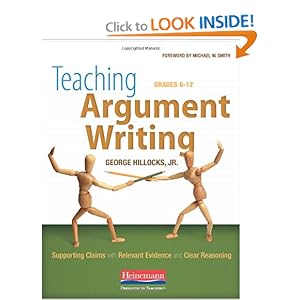
This blog post from a teacher directly integrates an argument writing text by George Hillocks, Jr., Teaching Argument Writing, Grades 6-12 (with a bonus handout!) as a strategy for students to attack math word problems

11 August 2013

Teaching Argument Writing...for Preschoolers! (and Anyone Else)


I had the pleasure of attending a two day training over the summer with the Gateway Writing Project about teaching argument writing and how we can use it to support the need for evidence-based writing in the Common Core ELA and math standards. 


  • CCSS.ELA-Literacy.W.9-10.1 Write arguments to support claims in an analysis of substantive topics or texts, using valid reasoning and relevant and sufficient evidence.
  • CCSS.ELA-Literacy.W.6.1 Write arguments to support claims with clear reasons and relevant evidence.
  • CCSS.Math.Practice.MP3 Construct viable arguments and critique the reasoning of others.


Although the requirements for thinking abstractly and putting together objective, argument pieces are not introduced until grade 6, the foundation of vocabulary, thinking and process of gathering evidence, making claims, and evaluating warrants could ideally begin in earlier grades as students write explanatory pieces.

Before I get ahead of myself, let me quickly define for you a warrant and a claim as from this book by George Hillocks, Jr., Teaching Argument Writing, Grades 6-12.


"Warrants may be common sense rules that people generally accept as true, laws, scientific principles or studies, and thoughtfully argued definitions." (Hillocks, pg xxiii)
Claims are the statement or value you are trying to prove the evidence supports. (Hillocks, pg xix)


But What Does That Have To Do With Teaching Preschoolers?

I had the pleasure of spending so much time watching my children, 3 years, 8 months, and 2 years learn and play this summer, so most of what I'm processing as a teacher right now is through my lens as their teacher this summer. Also, if you can communicate an idea to a 3 year old, you know you're set for the intended audience. :)

Of course, I wasn't sitting down with my daughter this evening and discussing vocabulary with her - we weren't even writing anything. Our exposure to argument and reasoning was during story time before bed.


Breaking It Down

We read Pinkalicious: The Princess of Pink Slumber Party, which recently came from the library.


The plot of this story doesn't really matter. You just need to know that Pinkalicious has a slumber party, and one of the friends ends up having a fear of falling asleep at another house.

Pinkalicious gets the girl to imagine various sounds and smells around the house are from a happy guardian dragon.


We met the dragon and I thought, "Interesting time to test some reasoning," so, very naturally, in my best inquisitive voice, I asked Lucy, 
"Do you think this is a mean dragon, or a nice dragon?"
"It's nice."
"How do you know?"
"Because its smiling!"  ::she points to the dragons mouth::
"Ah, and so usually when people are nice, they smile."
We continue on the story, and I'm happy to report, the little girl has no problem falling asleep.


Connecting to Terminology

Lucy did not produce an entire argument on her own, of course, but would you even expect that of all your middle schoolers or 9th graders? With some scaffolding questions, she was able to show the bones of some basic reasoning, however.

Claim: In response to my leading question, Lucy's claim is that This is a nice dragon.
Evidence: When I asked Lucy how she knew, she easily pointed out that the dragon was smiling.

In the experience of my own classroom with something like classifying functions, the process has been the same. I might ask, "Is this a quadratic function," to which a student at first may only respond, "Yes," but after I ask, "How do you know," she will often be able to point out a defining characteristic from a table, graph, or equation.

Warrant: As defined by Hillocks, a warrant is often something generally known. Kids learn quickly that they can usually trust adults or other kids that are smiling. Lucy left this off of her "argument," but warrants are the bones that support claims.

While warrants in an English or Social Studies class may be a little more subjective, I think STEM subjects generally have a stronger leg to stand on when picking out and using warrants. I explained warrants to a colleague today in the math office as being the properties and laws our students (often) write down and (rarely ever) use in their problem solving.


In the Classroom

The first several times you attempt argument writing with your students, I think it may end up looking and feeling a lot like my conversation with Lucy. I think that has to be okay.  Use guiding questions in pre-reading. Support them with definitions and clarify/refine their usage of warrant/ claim/ counterclaim. Restate their conclusion so they can have a chance to analyze if it "sounds" right once they've heard it outside of their own head or from their paper.