Showing posts with label #ccss. Show all posts

17 October 2014

That Common Core Subtraction Problem

Its hard to have NOT seen a variation on this problem over the past year.


The basic premise is this: Students are presented a subtraction problem, but instead of performing the traditional stacking/borrowing algorithm, evil public school common core teachers force students to jump through extra hoops. Students add chunks of numbers to the lower value to get to multiples of 5, 10, and then the higher value in an effort to find the difference between the values.

Every time I see this shared on social media its from a politically conservative non-educator using it as a tool to illustrate how big government getting its hands into our locally controlled schools makes things unnecessarily complicated (and ultimately, worse).
Here's the problem with using this ONE standard to characterize and criticize "common core math" - its the same thinking that our students and families use when they say things like, "all I need to be able to do is count my money. I don't need ______."

This question is meant to address a 1st grade standard about operations and algebraic thinking. The point is getting kids to understand multiple ways to manipulate numbers.
CCSS.MATH.CONTENT.1.OA.C.6Add and subtract within 20, demonstrating fluency for addition and subtraction within 10. Use strategies such as counting on; making ten (e.g., 8 + 6 = 8 + 2 + 4 = 10 + 4 = 14); decomposing a number leading to a ten (e.g., 13 - 4 = 13 - 3 - 1 = 10 - 1 = 9); using the relationship between addition and subtraction (e.g., knowing that 8 + 4 = 12, one knows 12 - 8 = 4); and creating equivalent but easier or known sums (e.g., adding 6 + 7 by creating the known equivalent 6 + 6 + 1 = 12 + 1 = 13). (source: corestandards.org)
Before you're ready to confirm your contempt for core standards, think back to your own math experience. I've found that most "non-math" people often prefer problems and learning environments in which there is more than one "right" answer. The point of this question is to build mathematical thinkers that can adapt their thinking to look for solutions when their first or second attempt is unsuccessful.

22 June 2014

Argument Writing in Math - the Oldest "Fad" in Instruction

Either you are a long-time teaching vet and you've said this or you've heard one say something like it - "Common core is just a next the fad. We've seen things like this come and go just like NCLB did."

It's true that a lot of the content and practice standards we see in the common core may only be shuffled content from the SHOW-ME standards and course-level objectives we already had in Missouri. To think that the rest is only based on the latest fads and research, however, is to have misread the document and dishonor the history of mathematics. 

Look at this from the standards for mathematical practice (my favorite part of common core).

If you're not careful, getting your kids to construct arguments can feel like another add-on to curriculum that rarely gets anything taken away. There are probably going to be enough shifts within the content standards that actually do represent changes to your classroom (for example, descriptive statistics in algebra) for you to get bent out of shape about the things that should be there anyway. 

If constructing arguments in our math classes is the reaction to a call for "rigor and relevance" and just another fad, then I want to remind you that it's perhaps the oldest "fad" in instruction.


If you're familiar with our old friend Euclid, then you know that the whole purpose of his work was to build arguments proving the geometric ideas of his contemporaries. It's commonly agreed that Euclid did not make up the ideas from Elements, but that instead, he was the first to curate and examine what was already being discussed. 

Aren't our students working in a similar environment? There's little to be "discovered" in planar geometry at this point, but we can still do well engaging students in the same work of critiques and proof gathering as Euclid and great mathematicians have practiced for millennia. 

Is the idea of argument and proof new to the current generation (post NCLB) of math students? Perhaps. Should we go back to teaching two column proofs the way we did it fifteen to twenty years ago? I don't happen to think so. I mean, there's a reason that Geometry instruction became more formulaic in this century - two column proofs are hard, and the rigidity of their structure turns off kids who are already struggling to find relevance in their work. I prefer flowchart or paragraph proofs because flowcharts have more cross-curricular appeal (logic and systems planning for coders), and paragraph proofs are more familiar (and therefore approachable) to the non-fiction writing our students already do in their other classes. Which students should do this? Everyone. Keeping proofs only in honors classes or with the "good" kids is prejudiced and demeaning to "regular" students. Will it take more work getting "regular" students to think critically? Probably. I think the way you package argument writing and proof to your students has a huge determining factor in their attitude toward it and belief that they can do it. 

Present it as a trial or a chance to argue with you (or each other). Kids love debates.

10 June 2014

The Claims We Make About "The Real World"


I remember a strategy the teachers in my elementary school all seemed to use when they felt like we were slacking on effort or gripping about the difficulty of some piece of content.

TEACHER 1: (to the class) One moment please, Mr. Smith needs to talk to me about something
The two teachers speak quietly by the door about something the students usually can't pick up.
TEACHER 1:  (to the other teacher, but loud enough for everyone to hear) You know, Mr. Smith, we're working on our long division right now, and a lot of my students seem to think it will be okay if they don't ever master this. Do you think that will work out next year?
TEACHER 2: (with the same inflection as the last question) Oh, no! That won't fly at all in 5th grade! You know, 4th graders, I've been hearing a lot about your, and I think there are a few of you that aren't gonna make it next year. In fact, I think maybe some of you would be better off getting held back... Ya'll are gonna be in for a surprise.
The students used to doing well, who were probably not the ones he was really referring to, all stress out for the rest of the day and into the evening about potentially repeating the 4th grade.

We do the same thing to our high schoolers, too, right? "That won't work in the real world..." I've the pleasure working with EdPlus and Pathways to Prosperity this week designing project based learning curricula resources for our classrooms next year, so the real world is high on my mind. Perhaps the best part of the program is the full day I'll be spending at Ameren headquarters on Tuesday, one-on-one rotating through with representatives from every department. The goal of Tuesday is to get an idea best what the real world really means in 2014.


Do teachers do this because they KNOW its true, or are they trying to make a point out of good intention?

Here's a list of things I'm planning on asking the Ameren workers I'm with on Tuesday that might be either wrong, or at least misrepresented -

"You need a scientific calculator because your smartphone isn't going to be able to do enough in a real job.""What are you going to do when the technology isn't there anymore to fall back on?""You can't NOT do fractions - fractions are in the real world.""You can either go to college or work at McDonald's.""You have to memorize this so you don't have to look it up at your job.""If you want a job that supports a good lifestyle, you're going to need a college degree.""Everyone uses math."
"Everyone writes" "You MUST show your work in a certain way, or else I'll take off points. Your boss is going to expect your work to be how he or she wants it!"

I'll give you a report back later this week!

05 June 2014

Argument Writing in Math: Getting Started

Are you an English teacher prepping a training on argument writing for the teachers in your building/district (and you want to be applicable to those STEM folks)? Are you a teacher that just went through an argument writing training that left you wanting more? Are you a math teacher that wants to integrate more logic, reasoning, and writing into your course? (Let's be friends!) Whoever you are, I wanted to share a few thoughts and resources to get you started on your argument writing (and thinking) in a math class. If you'd like more of a primer on argument writing in general, check out this post I wrote after I practiced some argument "writing" with my 3 year old daughter last year. (Teaching Argument Writing for Preschoolers...and anyone else!)


The most natural application of argument writing is in proofs, which most often come up in Geometry, and should also usually be used in Algebra (but rarely are in my experience). To make a common core connection, standard for mathematical practice #3 requires students to "Construct viable arguments and critique the reasoning of others."

Most students experience with proofs (and perhaps you remember your own) is with column proofs like this, for proving things about angles, line segments, or shapes.
Have I induced any terror sweats yet?
But proofs can also be written in paragraph form, which is where the English training and Hillcock can be applied. Reasons are the warrants, the statements are evidence, and claims will be what must be proved. "Prove that angle A is a supplementary angle," or "prove that the lines defined by y=2x+3 and y=2x-25 are parallel"

But...I don't even know how to explain what a proof is! 
Watch this adorable TED-Ed video introducing and explaining the basis and application of mathematical proof.

Want some more? Here's a resource from Berkeley on mathematical logic
"First, a proof is an explanation which convinces other mathematicians that a statement is true. A good proof also helps them understand why it is true. The dialogue also illustrates several of the basic techniques for proving that statements are true.

Table 1 summarizes just about everything you need to know about logic. It lists the basic ways to prove, use, and negate every type of statement. In boxes with multiple items, the first item listed is the one most commonly used. Don’t worry if some of the entries in the table appear cryptic at first; they will make sense after you have seen some examples.

In our first example, we will illustrate how to prove ‘for every’ statements and ‘if. . . then’ statements, and how to use ‘there exists’ statements. These ideas have already been introduced in the dialogue." - from Introduction to Mathematical Arguments (http://math.berkeley.edu/~hutching/teach/proofs.pdf)

A couple more resources for your classroom:

1. "Making arguments with equations, figures, and images" - (http://wacillinois.wordpress.com/2014/04/22/making-arguments-with-equations-figures-and-images-writing-in-stem/)

As soon as you have students start writing more in math class, some of them will start trying to write out EVERYTHING. The point of this post is that sometimes mathematical symbols are still most appropriate

2. "Developing argument writing in math using crime scene investigations" -(http://teacherleaders.wordpress.com/2012/12/15/developing-argument-writing-in-math-using-crime-scene-investigations/)

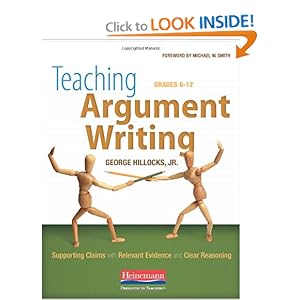
This blog post from a teacher directly integrates an argument writing text by George Hillocks, Jr., Teaching Argument Writing, Grades 6-12 (with a bonus handout!) as a strategy for students to attack math word problems

16 April 2014

Should Your Students Be Practicing Typing for CCSS Assessments?


The Problem Ahead
There is a lot of concern among a lot of elementary teachers I know about the younger kiddos' proficiency with computer skills necessary for completing Missouri's version of the Smarter Balanced Assessment field test later this spring.

I understand the concern. When we're trying to eek out every accreditation point we can, it would be a SHAME to miss the mark because our kiddos knew what they needed to know, but where unable to communicate their knowledge because they were uncomfortable with the interface, typing skills, or mouse skills that will be required of them on this web-based assessment.

So, to address the concerns, many of them have been discussing using the labs in their buildings to have kids practice typing on software or web-based typing games. There's irony here, right? Not only are we teaching to the test now, we're teaching to the skills for regurgitating the skills on the test. Forgive me if I'm out of place here - I have only a small amount of experience with elementary from my year subbing in 2007 and 2008 - but this doesn't seem rational. Elementary teachers are pulled a myriad of directions every day trying to fit in writer's workshops, reader's workshops, social studies, science, math, and specials, and already don't have enough time for their content, but we're going to advise they take time from content and relationship for kids to play typing games?

We don't need them to become home-row drones that crank out 80 wpm. We need kids that are comfortable typing real documents. We need kids that can take something they may have written down on a piece of paper and transfer it to a text-box in the testing environment. We need kids that know how to type out some math as simple even as 8+7=15 without searching for each symbol.

Are There Relevant Activities Can You Do To Practice Typing? (when all you have is lab)
Here's a quick list (this is one of things that are great for searching on Pinterest)

  1. Keep writer's workshop drafts or journals in a notebook, have students choose their best to type on lab day and publish to share online
  2. Pair students on a collaborative doc tool and take turns writing passages of a story
  3. Practice spelling words
  4. Choose an article or nonfiction passage in one of your content areas and write summary statements per paragraph.
  5. After a science experiment in the classroom, students write up a "report" detailing their hypothesis, method, results, and conclusion.
  6. Have students choose a recent leveled book they've read and write a review on Amazon or this site from Scholastic.
  7. Create a multiplication or factors table for personal use during math time.
Conclusion
Are "computer skills" important for our students? Absolutely. However, if we think about preparing them for CCSS assessments as another extra task, we miss the point. Skills practice and refinement can and should be integrated with content-specific activities - your students will be better equipped to transfer their skills when they've gained them within a "real" context.

17 January 2014

CCSS Math, Cognitive Verbs, and Rigor

The title of this 40 minute PD session, "CCSS Math", is admittedly vague, which is a hard sell for people choosing PD sessions to attend, but as a presenter its a bit of relief because I can choose to focus on what interests me.

We've been talking a lot about "rigor and relevance," so I wanted to highlight the connections between the action verbs in the Algebra 1 standards and the verbs in the DOK chart so we could at least see that if we're achieving one, we'll probably hit the other. Whenever possible, I will try to avoid heaping on "add-ons".


WEBSITES REFERENCED IN THIS TRAINING
Ferguson-Florissant CCSS Resources
ffsdccss.weebly.com

FFSD Curriculum and CCSS Intranet Resources (Use the login Kevin Voepel shared with you)
http://training.fergflor.k12.mo.us/Curriculum/

Illustrative Mathematics
www.illustrativemathematics.org

Next Network Gold Seal Lessons
http://www.nextnetwork.org/spn/article/ctop/Gold-Seal-Lessons

Inside Mathematics
www.insidemathematics.org

CCSS Cognitive Verbs
Teaching Cognitive Verbs

I KNOW the Common Core Standards, But... 3 Lesson Resource Sites to Use Next Week


Rigor. Relevance. Cognitive Verbs. Instructional Shifts. If your district is even remotely on the ball in preparing you and your students for Common Core implementation, you've heard these buzz words, and hopefully know some of what more will be expected of our students operationally.

But what does that LOOK like?  I think the number one question I hear whispered around me during Common Core training sessions has been pleas for examples of lessons integrating the standards.

Here are three lesson resource websites that are navigated according to math instructional and practice strands.


"Illustrative Mathematics provides guidance to states, assessment consortia, testing companies, and curriculum developers by illustrating the range and types of mathematical work that students experience in a faithful implementation of the Common Core State Standards, and by publishing other tools that support implementation of the standards."


"Gold Seal Lessons provide teachers model, proven lessons ranging from one day to three weeks that they can implement.

Each lesson is designed to teach to specific standards/benchmarks/objectives and centered around a highly motivating theme, activity, or project. Lessons are typically multidisciplinary and deal with real-world situations or problems. Additionally, Gold Seal Lessons should challenge students to learn and perform in a variety of different ways. They may be asked to research, write, compute, model, demonstrate, build, survey, or report in a variety of academic, technical, work, or community environments."


"Inside Mathematics is a professional resource for educators passionate about improving students' mathematics learning and performance. This site features classroom examples of innovative teaching methods and insights into student learning, tools for mathematics instruction that teachers can use immediately, and video tours of the ideas and materials on the site."


All three of these sites feature lessons you could use in your classroom next week. The best way to begin implementing common core or anything new in your classroom is to start implementing common core in your classroom.

07 October 2013

Writing in Math: Modeling is Powerful


My students encounter writing most in my AP Statistics class. Because of the responsibility to my students to prepare them for an AP exam that will require them to justify the statistical tests they conduct, the conclusions they make, and the observations they draw from graphs, data sets, or computer outputs, I have no choice but to engage them in writing tasks.

Students will not learn to write technically on their own. It's unnatural. It's "hard."
For the majority of my students, AP Statistics is their first exposure to sustained, technical, and descriptive writing. For the most part they've had short answer responses on some quizzes in other courses that will require them to explain "why" they think they're answer is reasonable, or how they came to their answer, but I find myself stretching and pulling all of 1st quarter to get these kids to write more than a sentence per prompt question. 

Consider the following histogram of a roughly symmetric, normal-ish distribution (if I'm losing you there, just know that this bar graph should be symmetric with a high peak in the center and long tails to both positive and negative infinity):

A pretty common prompt in the section where normal curves are introduced would ask something like, "Describe the shape of the distribution." Students usually feel pretty good about themselves if they remember to point out that its symmetric, and has a single peak. If they're getting frisky, they'll mention the tails off to the left and right, and point out the because the distribution is not skewed (with the data clumped in the right or left with a long tail to either side), that we know the mean and median would be roughly value, in the middle of that peak. 

I've come to expect these habits early in the year, so I lean heavy on giving positive feedback for effort (they wrote something), and always give a more specific example of how I would have refined what they said, or I read from my solution manual (sometimes even correcting the manual if I think the manual could have been more specific).

Students cannot know good technical writing without reading technical writing. 
Ironically, I think your textbook is a good place to start, because every section has passages you can easily pull that attempt to succinctly explain vocabulary or walk students through a procedure.

You hope there comes a time in every student's educational career where they stop filling their writing with flowery words that don't mean anything; that they would get to the point, especially in technical writing. However, the pendulum soon swings the other way and students write much less than they should, forcing the reader to assume much of the knowledge the student should be demonstrating.

To refer to the histogram again, I think a student given a prompt of, "Describe the histogram," or "Describe the characteristics of this data set" that had not been introduced to statistical terminology would probably write too much, and still not relay the point about symmetry and the placement of the mean/median. "There are 12 bars on the graph. The first one starts and -3 and goes up a little bit past 0.0..."

I've written all of this so I could share how embarrassingly inspired I was reading this report of a recent Pew Research Survey on the Affordable Care Act, and the role of Republicans vs. the President in the shutdown.

The writer of the report spent several paragraphs describing their methods, the lengths the survey designers took to eliminate response bias from the participants, and examining the bias they were unable to eliminate through their methods. It's just a lot of good, descriptive, writing that will be great for the Experiment Design chapter in the AP Stats curriculum. 
"The analysis in this report is based on telephone interviews conducted October 3-6, 2013, among a national sample of 1,000 adults 18 years of age or older living in the continental United States (500 respondents were interviewed on a landline telephone, and 500 were interviewed on a cell phone, including 250 who had no landline telephone). The survey was conducted by interviewers at Princeton Data Source under the direction of Princeton Survey Research Associates International. A combination of landline and cell phone random digit dial samples were used; both samples were provided by Survey Sampling International. Interviews were conducted in English. Respondents in the landline sample were selected by randomly asking for the youngest adult male or female who is now at home. Interviews in the cell sample were conducted with the person who answered the phone, if that person was an adult 18 years of age or older. For detailed information about our survey methodology, see: http://people-press.org/methodology/. 
The combined landline and cell phone sample are weighted using an iterative technique that matches gender, age, education, race, Hispanic origin and region to parameters from the 2011 Census Bureau’s American Community Survey and population density to parameters from the Decennial Census. The sample also is weighted to match current patterns of telephone status, based on extrapolations from the 2012 National Health Interview Survey. The weighting procedure also accounts for the fact that respondents with both landline and cell phones have a greater probability of being included in the combined sample and adjusts for household size among respondents with a landline phone. Sampling errors and statistical tests of significance take into account the effect of weighting. The following table shows the unweighted sample sizes and the error attributable to sampling that would be expected at the 95% level of confidence for different groups in the survey: 
 
Sample sizes and sampling errors for other subgroups are available upon request.
In addition to sampling error, one should bear in mind that question wording and practical difficulties in conducting surveys can introduce error or bias into the findings of opinion polls.
"

30 August 2013

Doing Statistics on Scientific Calculators, Grades 6-12

I'd be willing to bet that every approved syllabus on the College Board website for AP Statistics says that a graphing calculator (probably a TI, to be more specific) is required for success in the course. And while that probably IS true for AP Stats, that doesn't mean that all of the other kids doing statistics in your building need one!


Arguments Against Performing Statistical Calculations on Scientific Calculators
Whether you've said these things or know someone who has, I think its a prevalent attitude in schools because I've seen enough math teachers who cringe at the experience they had in college with statistics.

  • "I barely ever get to stats in my curriculum, and when I do, my students just do mean/median/mode. It's a lot easier to just have them calculate that by hand, than teaching them how to use their individual model of calculator."
  • "There's more value in having students perform these by hand so they can practice perseverance and have an understanding where the numbers come from."
  • "If kids want to study statistics, they can do it in high school. We just do means and averages in my class."

Once Again, Common Core Changes Everything
As soon as the 6th grade, students are to be able to use descriptive measures like mean, median, and standard deviation to make decisions. Trust me when I say I don't really rely on a middle school student's ability to consistently compute a variance or standard deviation for a data set using the formula.
You can make the process look simpler, but then you have a big chart on your paper, which also stresses kids out

Here are a few of the standards from 6th to high school: (from corestandards.org)
  • CCSS.Math.Content.6.SP.B.5 Summarize numerical data sets in relation to their context, such as by:
    • CCSS.Math.Content.6.SP.B.5a Reporting the number of observations.
    • CCSS.Math.Content.6.SP.B.5b Describing the nature of the attribute under investigation, including how it was measured and its units of measurement.
    • CCSS.Math.Content.6.SP.B.5c Giving quantitative measures of center (median and/or mean) and variability (interquartile range and/or mean absolute deviation), as well as describing any overall pattern and any striking deviations from the overall pattern with reference to the context in which the data were gathered.
    • CCSS.Math.Content.6.SP.B.5d Relating the choice of measures of center and variability to the shape of the data distribution and the context in which the data were gathered
  • CCSS.Math.Content.7.SP.A.2 Use data from a random sample to draw inferences about a population with an unknown characteristic of interest. Generate multiple samples (or simulated samples) of the same size to gauge the variation in estimates or predictions. For example, estimate the mean word length in a book by randomly sampling words from the book; predict the winner of a school election based on randomly sampled survey data. Gauge how far off the estimate or prediction might be.
  • CCSS.Math.Content.HSS-IC.B.3 Recognize the purposes of and differences among sample surveys, experiments, and observational studies; explain how randomization relates to each.
  • CCSS.Math.Content.HSS-IC.B.4 Use data from a sample survey to estimate a population mean or proportion; develop a margin of error through the use of simulation models for random sampling.
  • CCSS.Math.Content.HSS-IC.B.5 Use data from a randomized experiment to compare two treatments; use simulations to decide if differences between parameters are significant.
  • CCSS.Math.Content.HSS-IC.B.6 Evaluate reports based on data.
  • CCSS.Math.Content.HSS-ID.A.4 Use the mean and standard deviation of a data set to fit it to a normal distribution and to estimate population percentages. Recognize that there are data sets for which such a procedure is not appropriate. Use calculators, spreadsheets, and tables to estimate areas under the normal curve.
How Are My Kids Going To Do All of This??
The good news: A built-in function to most every scientific calculator is the ability to enter a simple list and run a 1-variable stats analysis to get (at the very least) the distribution's count, mean, variance, and standard deviation.
More good news: According to Smarter Balanced's testing manual, students taking the high school tests will have access to statistical calculators on the test.
The bad news: The keystrokes are a bit different on every model, so teaching your students to use their scientific calculators to get measures of center or spread from a dataset will have to be more about principles of the process (entering the data into a list, finding the button/menu that has your mean/median/standard deviation in it), than it will be about walking through specific keystrokes with the whole class.

Tutorials To Share
You don't have to be an expert. Watch these yourself, share with your students on Edmodo or your class webpage and students can review the video relevant to their needs.

TI-30XS (Multiivew)


TI-30XA


TI-30X IIS


Casio fx-991ES


Casio fx-85ES


Casio fx-83MS


These are all the calculators I see MOST frequently in my lower level math classes. If you or your students have a different model, a simple Google or YouTube search with "statistics on [your model here] should at least get you started.


11 August 2013

Teaching Argument Writing...for Preschoolers! (and Anyone Else)


I had the pleasure of attending a two day training over the summer with the Gateway Writing Project about teaching argument writing and how we can use it to support the need for evidence-based writing in the Common Core ELA and math standards. 


  • CCSS.ELA-Literacy.W.9-10.1 Write arguments to support claims in an analysis of substantive topics or texts, using valid reasoning and relevant and sufficient evidence.
  • CCSS.ELA-Literacy.W.6.1 Write arguments to support claims with clear reasons and relevant evidence.
  • CCSS.Math.Practice.MP3 Construct viable arguments and critique the reasoning of others.


Although the requirements for thinking abstractly and putting together objective, argument pieces are not introduced until grade 6, the foundation of vocabulary, thinking and process of gathering evidence, making claims, and evaluating warrants could ideally begin in earlier grades as students write explanatory pieces.

Before I get ahead of myself, let me quickly define for you a warrant and a claim as from this book by George Hillocks, Jr., Teaching Argument Writing, Grades 6-12.


"Warrants may be common sense rules that people generally accept as true, laws, scientific principles or studies, and thoughtfully argued definitions." (Hillocks, pg xxiii)
Claims are the statement or value you are trying to prove the evidence supports. (Hillocks, pg xix)


But What Does That Have To Do With Teaching Preschoolers?

I had the pleasure of spending so much time watching my children, 3 years, 8 months, and 2 years learn and play this summer, so most of what I'm processing as a teacher right now is through my lens as their teacher this summer. Also, if you can communicate an idea to a 3 year old, you know you're set for the intended audience. :)

Of course, I wasn't sitting down with my daughter this evening and discussing vocabulary with her - we weren't even writing anything. Our exposure to argument and reasoning was during story time before bed.


Breaking It Down

We read Pinkalicious: The Princess of Pink Slumber Party, which recently came from the library.


The plot of this story doesn't really matter. You just need to know that Pinkalicious has a slumber party, and one of the friends ends up having a fear of falling asleep at another house.

Pinkalicious gets the girl to imagine various sounds and smells around the house are from a happy guardian dragon.


We met the dragon and I thought, "Interesting time to test some reasoning," so, very naturally, in my best inquisitive voice, I asked Lucy, 
"Do you think this is a mean dragon, or a nice dragon?"
"It's nice."
"How do you know?"
"Because its smiling!"  ::she points to the dragons mouth::
"Ah, and so usually when people are nice, they smile."
We continue on the story, and I'm happy to report, the little girl has no problem falling asleep.


Connecting to Terminology

Lucy did not produce an entire argument on her own, of course, but would you even expect that of all your middle schoolers or 9th graders? With some scaffolding questions, she was able to show the bones of some basic reasoning, however.

Claim: In response to my leading question, Lucy's claim is that This is a nice dragon.
Evidence: When I asked Lucy how she knew, she easily pointed out that the dragon was smiling.

In the experience of my own classroom with something like classifying functions, the process has been the same. I might ask, "Is this a quadratic function," to which a student at first may only respond, "Yes," but after I ask, "How do you know," she will often be able to point out a defining characteristic from a table, graph, or equation.

Warrant: As defined by Hillocks, a warrant is often something generally known. Kids learn quickly that they can usually trust adults or other kids that are smiling. Lucy left this off of her "argument," but warrants are the bones that support claims.

While warrants in an English or Social Studies class may be a little more subjective, I think STEM subjects generally have a stronger leg to stand on when picking out and using warrants. I explained warrants to a colleague today in the math office as being the properties and laws our students (often) write down and (rarely ever) use in their problem solving.


In the Classroom

The first several times you attempt argument writing with your students, I think it may end up looking and feeling a lot like my conversation with Lucy. I think that has to be okay.  Use guiding questions in pre-reading. Support them with definitions and clarify/refine their usage of warrant/ claim/ counterclaim. Restate their conclusion so they can have a chance to analyze if it "sounds" right once they've heard it outside of their own head or from their paper.