Showing posts with label reading. Show all posts

24 July 2015

Stop Reading Blog Posts - Go Read a Book! (Okay, Finish This Post First.)


The St. Louis County Library summer reading program is giving out free +Chipotle Mexican Grill for completion of the requirements, so a month or so ago, I was gently encouraged by +Beth Baker that I would definitely be pulling my weight around here and make sure to read 6 books by her birthday (Aug 1st).

I always characterize myself as a reader, but I spend a lot of time reading from from digital magazines and/or blogs over time reading ebooks or actual books, so the commitment (and light) required of me this summer completing the reading plan was a good stretching exercise!

Here's my shelf for the summer:

The CONTENT of these books is not necessarily anything different than what I would read typically from a blog post I found on social media, but the way you INTERACT with a book is different, in my opinion.

This isn't an argument for physical books, just long-form reading. I think its important for adults and for our students to take a break sometimes from the pace of social media and ICYMI (in case you missed it) internet publishing of the 21st century and settle longer on a book.

Here's what I've noticed that gives BOOK reading more transformative power on your attitudes, opinions, and beliefs:

  • You're more likely to take on a book at the suggestion of an close friend than someone you casually know on social media, so you prepare yourself mentally/emotionally to be able to discuss this book with that person in the future (which lends to the book having a greater impact on you)
  • Especially in physical books, we write in the margins, we take notes to make sure we remember parts that we liked. We remember so we can talk about it or think about it later on when the book is no longer with us
  • Because reading a book takes longer than a 5 minute blog post, you spend more time chewing on/meditating on the ideas in the book. The ideas I reflect on in books end up being "themes" for my summer/semester/winter break. The things I pick up in blogs I more frequently file away for later into a "someday" folder in my brain
  • Reading a book gives a more complete, detailed representation of an idea than a single (or even a few) blog posts might. Where we blog writers might lean toward publishing our own opinions on a topic and then moving on, filling a book requires the author to round out their thesis with counter-arguments. 
  • The internet is awesome, and blogs have democratized the ability to use your voice and tell your story, but getting a book published is still a cultural benchmark of having "made it" as a credible source of expertise, giving more reliability to what you're reading. 
  • There's an army of editors and copywriters making sure that what leaves the publishing house for the printers is the best possible product, so you could argue that book reading is word-for-word a more valuable use of your time. You know how many editors this blog has? 1 1/4 - sometimes I make my wife pre-read my posts. 

What's this mean for our students?

For as much as you're reading blog posts like this one, your students...probably aren't. I think we need to continue to TEACH them to value books (not so much the physical artifact, but the idea of a book as long-form reading), and we need to challenge them to form ideas and opinions that are book-worthy.

A book-worthy idea probably has several quotes that makes for a great tweet on Twitter or a grainy image with text over it on Instagram, but its more nuanced than that. It's going to be fuller, more round, more complete. A book-worthy idea is one that you as the author have dedicated the time to and poured out the passion to write, rewrite, edit, and revise into a work that is more enduring than a tweet in someone's feed.

In science class, this is the analysis of an experiment and data set that you've spent weeks designing, implementing, compiling, computing, and interpreting.
In film and literature, its an analysis of many themes throughout an author's work
In math, its the solution to a real problem that the student has identified, determined the variables in the situation, and begun to model with equations and graphs
In history, its exploring and relating to narratives from a dynamic range of sources, then reflecting on what it all means.

I believe we only maintain an appreciation for these deeper, richer, slower ideas and works as we read and write them. Tweets are good, let us continue to connect! You and I obviously both appreciate blogs, too, but educators have a concurrent responsibility of modeling and encouraging this appreciation and thoughtfulness of book-worthy ideas.


07 June 2015

Give Your Students "College Ready" Texts They'll WANT To Read

Its no secret that the ACT (and success in college as a whole) is dependent upon a high-level of reading comprehension. The science section on the ACT has much, much more to do with reading and understanding a non-fiction, technical text than it does your memory of mitosis or Newton's 3rd law.

That being said, it be hard to avoid the importance of raising reading skills in my ACT Prep class this summer. I haven't looked at my students' benchmarked reading scores from the school year, but given the
"don't-you-dare-call-on-me" silence of death I've gotten our 2 days of class when I asked for a reader, I'd be willing to bet they are not high. I don't think the students at my school WANT to be poor readers, and most of our low readers probably carry some shame about and would put in work to raise their skills, but putting in the hard work of catching up using reading texts that are not of personal interest to them creates a mental barrier. Rather than hurdle/climb/scratch/claw over it, many of our readers go the easier route of blaming something/someone else for their deficiencies, or they resign to "I'm not a good reader."

As I was perusing the Chrome Web Store this week looking for more utility to add to my Chromebook, I ran into Newsela, a news aggregator that promises to give my students articles that will be of interest to them at a lexile/grade level score that I can set to best support them.

I had really hoped Newsela ran on some super platform that used some fancy coding to take any article a student could throw at and replace synonyms, interpret meaning, and chunk long passages into shorter ones, but apparently I live in the future.

Newsela DOES have a respectable amount of articles to choose from (updated daily), and I was even able to find one about the dance team from a school in my district that the +St Louis Post-Dispatch profiled last fall.

Here's what Newsela allows you to do with any of the articles on the site:

  • Assign to students for reading. From their student account, they pull up their "binder" to find what you have curated for them.
  • Set a lexile level for them to scaffold vocabulary weaknesses while focusing on comprehension
  • Assess comprehension with a quiz that they put together or a writing prompt
  • Highlight and annotate passages to give your students extra insight or further scaffold their reading.

To share some of how it works, here's a few screenshots of my perusing that article:

This is the layout of an article on Newsela. You have options to assign the article (or to hide it) at the top, the text in the main column with sharing buttons above the title, and choices to differentiate reading levels and assessment on the right in blue.


Newsela doesn't ONLY replace "higher" words for lower, the editorial staff also provides subtitles and headings the lower you go down lexicles. This is the same paragraph on the 5th grade and 12th grade reading level.


Is it a PERFECT tool for getting your students relatable content? Probably not, but it gets you a long way in its ability to provide choice and scaffolding for your readers, and its faster than a classroom trip to the library for students to find and choose books on the appropriate level.

07 June 2014

Traditional Textbooks Are Holding Back Your Students' Vocabularies

Do you use the dictionary tool embedded in the tools in your favorite eReader or browser? What about your students? Once your students are proficiently reading at a middle school level they probably aren't likely to run across (many) unknown words in popular fiction, but what about content specific words in textbooks or course specific literature like Shakespeare or Hawthorne?

Remembering from my own experience, your students traditionally have three choices (and these are still advocated, I know) - keep a paper dictionary at your desk/in your backpack to look up words whenever necessary, attempt to use context clues to get an idea, or skip over it and miss out on comprehension of the text.

I've got a lot of respect for students willing to keep that dictionary with them (or even willing to reference a standalone app), but why are we making it so hard on our students (or yourself)? When you give your students ebooks and web resources to read, definitions are a highlight-and-tap away. Your definition comes on-screen and in context.
Kindle for iOS 
IBooks
Safari for iOS

Imagine how you could unlock your students' potential to learn through reading if they weren't frequently skipping new words (or skipping the reading altogether because it seems insurmountable).

Ready to take the next step?
Your district may not have a license for the corresponding ebook to your text, but you can use these tools to get your students access to alternative texts they could use in class or on their own devices.

CK-12
You can find a free CK-12 ebook in iBooks and the Kindle store for many go your core subject needs (Algebra, Geometry, American History, Biology, Chemistry, etc.) 

CK-12 Flexbook
On the website from the resource above comes a related, customizable tool. I've had these on my class iPads for a couple years. I like them because you can create/compile your own text, or use one that another teacher has already made public. I usually also post a download link on my class website for students' personal downloading pleasure.perfectly formatted 

iBooks Author 
This Mac app allows you to bring in text, images, and video to create an ebook perfectly formatted for iBooks (although it would still work in other ereaders, as well.) you can share your books created in iBooks Author just as I do with my Flexbooks from CK-12. 

Someone in your social network. 
Fellow AP Stats teacher, Julie Kindred (@jkindred13), has made most (if not all) of a stats book in iBooks Author and was willing to share her treasure with me. Maybe you are as fortunate as I am and have someone in your network who has done the same for your needs. Or you and a few friends could collaborate on one!

12 January 2014

The Daily 5 in Grades 6-12: Teaching Reading Strategies in Content Areas

This post is the 3rd in a series devoted to adapting the literacy tenets of "The Daily 5" to a secondary classroom with 50 minute periods. You can catch the whole series here.


I started to write about an activity that I did in AP Stats almost a year ago, but the IEP of "Tre'," one of my new students for the semester, has me stuck here. He is going to need a lot of support reading.
"Goals: Reading comprehension- Answer questions across the content areas and answering critical thinking questions independently with 65% accuracy."
This young man is a senior with a tested reading grade equivalency of 5th grade. What's even more shocking to me than the stated goal of 65% is that from my experience, those goals are usually optimistic at best. So, without interventions, I have a feeling this student can hit that goal with perhaps 50% accuracy.

Maybe you've even been there - (I hope you have challenged yourself this way) - you're reading a text from a subject you know little about and get very confused very quickly. Getting over that hump in my own self-selected readings was my main strategy from moving to a Social Studies certification from college into math. I did some confused reading for a few weeks, but reading real texts (books aimed mostly at the general public, but about mathematics instead of practicing hundreds of drills) is what soothed my mind as I left my first love to (what I thought would be) a much drier, boring, and objective subject.

There were probably several things that I read those months of which I could have answered critical thinking questions with only 65% accuracy, but I was able to improve my understanding of the texts because I had reading tools in my back pocket. I knew it was okay to look up definitions of words I wasn't quite confident with (and then definitions of words in the first definition!). I reread some paragraphs (and pages). Sometimes I paused to make connections of the content I was reading to a mathematician or concept I had read about in another book. I knew that having a text beyond my current understanding didn't mean I was dumb, but only that I had more reading to do.

So for "Tre'," its important that if we are going to commit to literacy in content areas, then we must also commit to teaching literacy strategies in the context of our content areas. Especially for students like "Tre'," its apparent that "he'll get it in his English or Reading class" is not going to be enough.

"I HAVE NO TRAINING IN THAT," you may be saying. That may be so, but that doesn't change your students' circumstances. Here are some resources to get your started:

Blog posts
25 Reading Strategies That Work in Every Content Area
9 Lesson Plans with Strategies from ReadWriteThink
How to Read a Nonfiction Text
99 Ways to Improve Your Students' Reading Comprehension
Reading in the Content Area - Pre, During, and Post Reading Activities (from +Kelly Fisher-Bishop)

Books
Teaching Reading in the Content Areas: If Not Me, Then Who? 3rd edition 
The Teacher's Essential Guide Series: Content Area Reading

03 January 2014

The Daily 5 in Grades 6-12: Boxplots Partner Reading

This post is the 2nd in a series devoted to adapting the literacy tenets of "The Daily 5" to a secondary classroom with 50 minute periods. You can catch the whole series here.

Daily 5 Tenet #3 - READ TO SOMEONE

Sit some seniors down in a classroom and tell them they're going to read to each other. They'll look at you almost as skeptically as I did this summer when a colleague had us do it at a reading training over the summer.

"Really," they think. "Do we have to," they ask. "Yep," You will answer.

I modeled it with a different random book I pulled out of the reading corner in my room, and I think that took some of the hesitancy out of it. Granted, my AP Stats students are usually up for anything, but I had full participation in this partner read today with no groaning and pleading.

Here was the text from our textbook, The Practice of Statistics, 2nd Ed.

Not the most engaging passage ever, but certainly not bad by textbook standards, and definitely high on ease of implementation.


How Do I Do This?
A partner read is as simple as it sounds. Two students take turns reading paragraphs to each other. Depending on the individual students' reading levels, partner read could be an opportunity to practice:
  • vocabulary building
  • reading fluently
  • listening to fluent reading
  • auditory comprehension
  • monitoring for understanding
You may be wondering, "Why not just have students read to themselves silently? I'd rather have that than a dozen kids all reading aloud at once."

I don't think I'm alone on this, and I know I've seen students do it - how often do you skip over information that ended up being important when you are reading to yourself? Yes, skimming is a great technique for speed reading, and is wonderful for getting the gist of an entire article, but I've seen my students routinely discover a few key words they missed reading to themselves after I make them read back to me aloud.


To The Next Level
Reading is always better with writing! Since your students will already be in partners, to wrap up the activity, I had them agree upon 2 summary statements for the passage. Here are a few samples.


I felt like these turned out more as facts-from-the-text than they were summary statements, but once they were shared in class, we got a clearer picture from their parts together.

01 January 2014

The Daily 5 in Grades 6-12: Making It Work

This post is the 1st in a series devoted to adapting the literacy tenets of "The Daily 5" to a secondary classroom with 50 minute periods. You can catch the whole series here.


"A lot of these apps would be great for getting your Daily 5 work in..."

I was at an Education Technology Conference last February watching +Kathy Knutson and +Holly Camacaro present on their use of iOS apps in their Kindergarten and 3rd graders respectively, and Kathy paused for a moment to see if she needed to briefly summarize Daily 5 for anyone.

In the room full of elementary teachers, I was apparently the only one that raised my hand. No problem, I've got Google. A very easy search on Google for "daily 5" gets you to the "The Daily Cafe," where you find out that Daily 5 is a literacy framework with 5 tenets:
  1. Read to Self 
  2. Work on Writing 
  3. Read to Someone 
  4. Listen to Reading 
  5. Word Work 
Exploring even just the Daily 5 website, it quickly becomes clear it is written to elementary teachers with time in their day to go through extended centers - something not feasible for me in a 50 minute class period. Because I work with elementary teachers on the district EdTech Team, I filed it away as useful for perspective, but otherwise ignored it.

When we returned to school in August, we were told that one of the goals for the year was a strategic literacy initiative, and that our main tool would be called "Daily 5" - every student reading 5 minutes a day in every class. While that could look like one of the 5 tenets listed above, it felt like an irrelevant add-on to me, so using what I know from my elementary friends, I decided to take one of the 5 "centers" and choose to do ONE for that class period.

Focusing on ONE of the "Daily 5" for my 50 minute period instead of tacking a sustained reading time to the end or beginning of the period provides several instructional advantages:
  • I can integrate the literacy work into what I would be doing that day anyway 
  • I can do "Daily 5" during any point of the period. Some days it is my lesson starter, other times it is the meat of instruction, and still others, it serves as a summary/assessment reflection piece at the end of the period. 
  • Students see an integration of literacy in their math curriculum instead of just reading in their math class(room). 
  • I do not make a point to hit every "5" every week, but I usually get at least three, so students are exposed to diverse literacy activities beyond passive reading. 
  • Because literacy is not planned for as an add-on, its effects are more likely to endure and I am more likely to be persistent and consistent in its integration. 

I plan to go into more depth on my literacy and technology efforts as my own Daily 5 presentation with +Abby Erwin at this year's METC conference nears, but just to get you started, here are a few activities I use pretty regularly.

I keep a cheat-sheet taped to the chalkboard next to my desk for easy reference while I'm planning - feel free to print this one!

11 August 2013

Teaching Argument Writing...for Preschoolers! (and Anyone Else)


I had the pleasure of attending a two day training over the summer with the Gateway Writing Project about teaching argument writing and how we can use it to support the need for evidence-based writing in the Common Core ELA and math standards. 


  • CCSS.ELA-Literacy.W.9-10.1 Write arguments to support claims in an analysis of substantive topics or texts, using valid reasoning and relevant and sufficient evidence.
  • CCSS.ELA-Literacy.W.6.1 Write arguments to support claims with clear reasons and relevant evidence.
  • CCSS.Math.Practice.MP3 Construct viable arguments and critique the reasoning of others.


Although the requirements for thinking abstractly and putting together objective, argument pieces are not introduced until grade 6, the foundation of vocabulary, thinking and process of gathering evidence, making claims, and evaluating warrants could ideally begin in earlier grades as students write explanatory pieces.

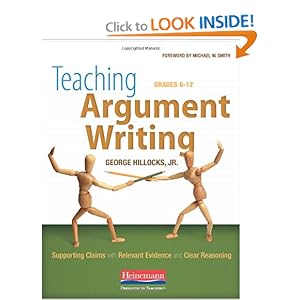
Before I get ahead of myself, let me quickly define for you a warrant and a claim as from this book by George Hillocks, Jr., Teaching Argument Writing, Grades 6-12.


"Warrants may be common sense rules that people generally accept as true, laws, scientific principles or studies, and thoughtfully argued definitions." (Hillocks, pg xxiii)
Claims are the statement or value you are trying to prove the evidence supports. (Hillocks, pg xix)


But What Does That Have To Do With Teaching Preschoolers?

I had the pleasure of spending so much time watching my children, 3 years, 8 months, and 2 years learn and play this summer, so most of what I'm processing as a teacher right now is through my lens as their teacher this summer. Also, if you can communicate an idea to a 3 year old, you know you're set for the intended audience. :)

Of course, I wasn't sitting down with my daughter this evening and discussing vocabulary with her - we weren't even writing anything. Our exposure to argument and reasoning was during story time before bed.


Breaking It Down

We read Pinkalicious: The Princess of Pink Slumber Party, which recently came from the library.


The plot of this story doesn't really matter. You just need to know that Pinkalicious has a slumber party, and one of the friends ends up having a fear of falling asleep at another house.

Pinkalicious gets the girl to imagine various sounds and smells around the house are from a happy guardian dragon.


We met the dragon and I thought, "Interesting time to test some reasoning," so, very naturally, in my best inquisitive voice, I asked Lucy, 
"Do you think this is a mean dragon, or a nice dragon?"
"It's nice."
"How do you know?"
"Because its smiling!"  ::she points to the dragons mouth::
"Ah, and so usually when people are nice, they smile."
We continue on the story, and I'm happy to report, the little girl has no problem falling asleep.


Connecting to Terminology

Lucy did not produce an entire argument on her own, of course, but would you even expect that of all your middle schoolers or 9th graders? With some scaffolding questions, she was able to show the bones of some basic reasoning, however.

Claim: In response to my leading question, Lucy's claim is that This is a nice dragon.
Evidence: When I asked Lucy how she knew, she easily pointed out that the dragon was smiling.

In the experience of my own classroom with something like classifying functions, the process has been the same. I might ask, "Is this a quadratic function," to which a student at first may only respond, "Yes," but after I ask, "How do you know," she will often be able to point out a defining characteristic from a table, graph, or equation.

Warrant: As defined by Hillocks, a warrant is often something generally known. Kids learn quickly that they can usually trust adults or other kids that are smiling. Lucy left this off of her "argument," but warrants are the bones that support claims.

While warrants in an English or Social Studies class may be a little more subjective, I think STEM subjects generally have a stronger leg to stand on when picking out and using warrants. I explained warrants to a colleague today in the math office as being the properties and laws our students (often) write down and (rarely ever) use in their problem solving.


In the Classroom

The first several times you attempt argument writing with your students, I think it may end up looking and feeling a lot like my conversation with Lucy. I think that has to be okay.  Use guiding questions in pre-reading. Support them with definitions and clarify/refine their usage of warrant/ claim/ counterclaim. Restate their conclusion so they can have a chance to analyze if it "sounds" right once they've heard it outside of their own head or from their paper.

23 May 2013

5 Reasons Why Common Core Will Kill Creativity


My district began compiling PD resources and formally thinking through #CCSS implementation for our administrators, teachers, and parents this week, so I've got common core on the brain.

On the whole, I think our districts' teachers still feel rather in the dark about what Common Core changes will and won't mean for their classrooms, but I think, in part, the action in Jeff City at DESE is to blame. Missouri is not a Race to the Top state, so there has been less funding available for the guiding the transition, so it makes sense, but disappointing nonetheless.

Locally, our Superintendent Dr. McCoy has been a vocal leader in some criticisms of common core and its effect on the creative freedoms of our students in their lit/comp classes.
To say creative writing and literacy for advancement and personal improvement is a focus in our district   would be putting it lightly. Dr. McCoy wears his literary and creative heart on his sleeve (in an all school assembly, even), and I believe many of students see him as a positive African-American role model because of it. (And his transparency inspired me, too.)

Last word of background, my friend at another high school in the district has seen high results in engagement through creative writing opportunities for her students and shared them in our #METC13 presentation.

So here are 5 things you might start missing if you have a passion for creative, written expression.

1. The classics are de-emphasized.
Do you feel like all you ever read in high school lit class were novels, short stories, and poetry? No longer the case. Our students do need more exposure and readiness to informational text, but find me someone who was inspired to change the world after reading an unbiased account of the migratory patterns of monarch butterflies.

2. Journal writing - where does it fit in?
In Missouri Course-Level Objectives, "reflective writing" is listed across the board for all high school courses. I value reflective writing from my experience as a student and an adult, and I think it can be transformative in understanding who we are, what we think, and what we know, and what we value. How are students to find themselves if they're only ever summarizing arguments and detailing main points and themes? Who will write the next century's Walden Pond?

3. Creative writing is devalued
As referenced in the last point, non-fiction, technical writing has been given at least half of the emphasis in the ELA standards, which means fiction writing had to be de-emphasized. Two different Missouri CLEs (W2A and W2D) currently require students to write considering "different audiences", and to employ "imagery, humor, voice, and figurative language." When you're a teenager and you feel like no one else hears you, how do you find freedom in a formal analysis of novel X, Y, or Z?

4. Less choice in composition style
Reading through the ELA standards for high school, what continuously sticks out to me is "analyze, analyze, analyze." writing styles or works. It seems to me that if CCSS are successful they'll have produced an army of literary critics, but who'll be left to criticize?

5. Less time to enjoy and appreciate literature and art.
Those times when you reread a passage because there is such beauty in the alliteration, or you stop in a speech because your heart is racing. If an ELA teacher is "doing" common core right, where does that fit in? Thinking of it this way, if I'm always analyzing my wife, I never appreciate and grow fonder for her. How will we inspire the next generation to beauty and emotion in written word?


But don't fret!  I've got 5 Reasons Why Common Core Promotes Creativity, too.

07 February 2013

Reading in Math Class: Think Alouds (Formative Reflection)

First, I wanted to celebrate the fact that I tried Think Alouds with this iMovie trailer. (I blogged about the lesson plan here on Tuesday.)


That being said, today felt like a train wreck. :)

I had originally intended to copy each handout on the same piece of paper so I could have a parallel notes kind of situation like this:


I didn't get my copies done, so my first thought was to just have the kids pull it up in our AP Stats shared Dropbox folder and annotate on their iPads with any of our note-taking apps (since they were already out to transcribe the whole experience with Dragon Dictation). The whole process was started to get overwhelmed with all of the tech layers I was throwing on top of the lesson, so I abandoned that and eventually just went old-school print out of the text from my Google Drive file, highlighting items of emphasis and writing their thoughts in the margins.

There's a lesson planning truth here: Always try out new stuff with your most resilient class. My AP Stats class is my smallest, and the students most agreeable to patiently working on something else for another class if/when I have to troubleshoot. They're also independent enough to do some extra work YouTubing or reading on their own later if necessary (which is crappy for a teacher to do when its unintentional, so of course, we try to limit that). :)

My Verdict:

Kelly Fisher-Bishop followed up to my comment on her post about Think Alouds and it seems to summarize my current thoughts on the strategy:
I think this strategy will take some time for it to work and run smoothly; students will have have trouble vocalizing their thoughts in the beginning, but after some practice and modeling (on your part) the students will eventually get the hang of it. If it becomes part of the class routine, then students will get better and better at using this new reading strategy.
 If you watched all of the trailer I shared at the beginning of the most, my kids really were "defying stereotypes" with the reading lesson. Part of the problem may have been the texts I ended up choosing, but I'm willing to rest right now on a level of discomfort they had a) reading aloud in class, b)reading in math class (although of any of the courses in our catalog, stats has the most reading as routine), and c) working in new groups (they usually just pair up with the person next to them. I truthfully may have thrown too many variables into this lesson to attribute the effect to any one of them).

Students' Verdict:

Here are some of their thoughts on the lesson (collected using Today's Meet).
"I liked that we worked in groups to figure out what the reading was talking about."
"Group work is nice, binomials are a little clear, could've gone over it as a class more. I learned more than if it would have been a ppt."
"I liked that we could use the iPads to help figure stuff out. If we had more time to talk about it afterward, that would have helped me more" 
"I like that we got to go over the material from two different websites n we reviewed it"
"Can we do a binomial problem in class together step by step?" 
They're usually nicer than I expect them to be. :) Two things I gather from these responses:
  1. they liked talking it out with their partner/group 
  2. a summary of the activity/application of what they learned was necessary to validate thoughts from the group and clear misconceptions that may have developed. 

Adaptations for YOUR class:

Using Dragon Dictation was a waste of time. The help in the app suggests that you speak directly into the microphone, which is unnatural and weird to do if you're trying to have a constructive conversation with a person. If I want to archive the audio next time, I would just use the recording utility in Noteability or SmartNote Free. As mentioned from the student comments, a summary of the learning and thinking that went across groups should have been compiled before we left - a couple ways to share could be Todaysmeet.com, a Google Doc that everyone edits as they wrap up their own conversations, or good ol' pieces of butcher paper for each group.

As far as choosing your text, its very important that the reading level is appropriate for your individual learners so they can get into the reading. A great opportunity for differentiation would be to group according to reading level and provide separate, approachable texts. My Stats class has been previously screened to make sure they could handle the reading required for the course, but when I try this with my Applied Math class next week, they will shut down if the reading is over the heads.

Have you tried Think Alouds before? Any other tips for my next attempt?

05 February 2013

Reading in Math Class: Think Alouds

Here's an attempt to synthesize a more lit-comp/ social studies/ science geared strategy for use in the math class. (We get used to that, am I right, math teachers?) For more info on think alouds, here's a post from Kelly Fisher-Bishop, an instructional coach in my district.


The point of a Think Aloud is to get students verbalizing the text, engaging with vocabulary, and forming an understanding of the nonfiction text. The "think aloud" part of the Think Aloud is a conversation between partners in which they explore meaning behind the words, connect concepts in the text to prior knowledge, define new words, and communicate their reasoning.

Archiving a think aloud could be done with Cornell Notes, a simple voice recorder, an app for notes and recording, and (what I'll be trying, the Dragon Dictation app, which would convert students' think aloud to text notes for later review, allowing them to focus on their dialogue.)

Math Class Adaptation:

My AP Stats kids did an introductory activity about binomial random variables (Lesson 8.1, TPS2e) today in class, played around with binomial coefficients and probability of discrete outcomes, and connected concepts (such as normal approximations) important in this lesson to material we've already mastered.

The purpose of this Think Aloud, then, will be to formalize the connections they made today by drawing definitions and concepts out of two different informational texts about binomial distributions, getting down definitions, and sorting out the reasoning behind the construction of formulas and when their use in appropriate.

I created a handout for them to read and annotate on, and I'm going to have them run the app the during step 2 of the Think Aloud, when most of the partner discussion will occur, and during their work on the practice exercise.
Handout 1, informational text 
Handout 2, Guiding Questions/Discussion Log

Although this is two pages, my plan is to print these on one sheet, side by side.


Here's a demo for the Dragon Dictation app

Adaptation for YOUR class:

Certainly if its common practice for your students to be reading informational texts, using Think Aloud with your students (and meta-cognitively modeling what you do most days anyway) should help your students construct sense and meaning. For instance, in math or science topics, I'd say most Wikipedia articles are very informative and could be very useful for students' understanding. A common problem I encounter, however, is that there is too much information in the article that becomes noise for what I want to be reading. Giving a tool to your students to sift out unnecessary information and methodically go through the text can make them more independent as learners and less dependent on you or only YouTube.