Showing posts with label lesson planning. Show all posts

25 November 2018

Are You Pumpkin-Spicing Your Classroom?

I'm not ashamed to say it - I'll crush a Starbucks PSL. I smile gleefully as I wait for that first sip of the season.(Pumpkin Spice Latte for the uninitiated, although it contains no actual pumpkin, which often confuses people, but to be fair, it's pumpkin SPICE, not pumpkin PIE. Back to the point.) There have been several years I've looked forward to the yearly onlaught of all things pumpkin spiced.

"I wish I could have pumpkin spice all year long," I thought one evening in front of the dry, non-dairy creamer at the supermarket. "If I buy a few of these, I can probably make them last several months at work. Win!"

I proudly pulled out my creamer the next day and sipped my clever coffee hack, looking forward to the months to come.

You probably can guess the end of this sorry. Just like Christmas carols, the Filet-O-Fish, and extended stays with family over the holidays, in order to appreciate a good thing, it's generally best for everyone if enjoyed in moderation.

"What in the world does your PSL obsession have to do with teaching?"

Fair question. Have you ever found yourself falling in love with a tech tool, website, or teaching strategy and wanting to use it ALL THE TIME? Kahoot! Quizizz. Quizlet. Thatquiz. KnowledgeHook. And that's just a list of formative assessment tools. I'm sure I could poll the internet and find websites from every content area, as well.

I've found that the magic bullet website/tool/strategy that is going to get 100% of your students engaged all the time only works for a period of time. A particular trait of the gifted students in my classroom is craving novelty. If they expect what's coming, be ready to be looking at kids tuning you out working on something else next time you look up.

Comfort is often unhealthy for us, too, right? We get complacent in comfort. Most of my students are building skills. Most of my kids are connecting with me relationally. Most of my students' parents came to conferences. You name it.

So, yeah...I crushed the Pumpkin Spice Life in my cereal bowl this morning, and I'm going to definitely be pulling from my greatest hits as we head into the final stretch of the semester next week, but I'm going to remember that not everyone likes PSLs as much as I do, and I can only truly appreciate pumpkin spice if it stays in the fall where it belongs.


30 April 2017

When It's (Not Quite) the End of the Year

 music justin timberlake funny gif justin timberlake gif its gonna be may GIF
Yeah! The end of the school year is soon upon us! Which also means you feel frazzled, your kids are spent, it's just in time for state testing, and you and or a close friend is leaving school a couple times a week wondering how you'll get through tomorrow.
 done jerry seinfeld im done over it GIF
I take a lot of comfort on days like that by centering on a few things I know about God and I know about myself. Whether I have a great day or a wretched wreck, God has me right where he wants me. You may have seen Jeremiah 29:11 quoted on Instagram or someone's living room decor - 
and you may have thought, "Yeah! I'm gonna start winning!" Welfare, future, hope...these are all good things that we want, right? So true, but I also don't believe this is always a promise that tomorrow might be rosy. I read this, think about my own children, and sit on, "...I know the plans I have for you..." When I take toys from my boys at bedtime because they won't go to sleep, my 5-year-old sometimes tells me, "YOU JUST WANT TO BE THE TAKER!" Its funny, because its true, but only in the sense that I know its good to all the sleep you need, and I'll do what I need to in order to help my boys get there...to understand that I value it and that it is for their "welfare" (to quote Jer. 29:11 again). 
Besides remembering that whatever hardship I'm going through is God ordained, I also like to dwell in the Psalms that teach us how to ache to God without losing hope. Psalm 42 came up in my reading plan today, and I found myself wanting to highlight the whole thing... Check it out (emphasis my own):
As a deer pants for flowing streams,
    so pants my soul for you, O God.
My soul thirsts for God,
    for the living God.
When shall I come and appear before God?[b]
My tears have been my food
    day and night,
while they say to me all the day long,
    “Where is your God?”
These things I remember,
    as I pour out my soul:
how I would go with the throng
    and lead them in procession to the house of God
with glad shouts and songs of praise,
    a multitude keeping festival.
Why are you cast down, O my soul,
    and why are you in turmoil within me?
Hope in God; for I shall again praise him,
    my salvation[c] and my God.
My soul is cast down within me;
    therefore I remember you
from the land of Jordan and of Hermon,
    from Mount Mizar.
Deep calls to deep
    at the roar of your waterfalls;
all your breakers and your waves
    have gone over me.
By day the Lord commands his steadfast love,
    and at night his song is with me,
    a prayer to the God of my life.
I say to God, my rock:
    “Why have you forgotten me?
Why do I go mourning
    because of the oppression of the enemy?”
10 As with a deadly wound in my bones,`
    my adversaries taunt me,
while they say to me all the day long,
    “Where is your God?”
11 Why are you cast down, O my soul,
    and why are you in turmoil within me?
Hope in God; for I shall again praise him,
    my salvation and my God.

"I shall again praise him, my salvation and my God." I think the longer you're in education, the more realize that your "favorite" students, or the ones whose memory you hold dearest, or the ones you take most pride in were relationships that felt really difficult a lot of days. They're the relationships that take a constant renewal of forgiveness on your part. Countless counseling sessions with any of your friends who will listen.  I've found that I'm most consistently able to draw on hope for those relationsihps, or for a season of a difficult class because I know that (a) teaching is a marathon, not a sprint, and that (b) whatever the outcome with that student or class, I know God's at work in me, and that eventually "I shall again praise him." 
"ALL THAT BEING SAID....HOW AM I GOING TO GET THROUGH TOMORROW, CHUCK?"
You know what, that's a good question. Here are some things that I try to keep myself interested in class as that gas gauge nears E and it's not quite time to review for finals. 
  • Throw in a new project. Maybe you've gotten into a routine of lecture/practice/lecture/practice and your kids are showing diminishing returns. Throw in a wrench and change things up
  • Change your seating arrangement. Seating totally shifts perspective, right! This might solve some other classroom environment problems that were cropping up, too. 
  • Change YOUR routine. Do you usually get to school early? Stay with the late crowd after-school and prepare for the next day then, instead. (or come in extra early if you're usually walking in with the kids). Go for a walk around the building during your plan time. 
  • Try a new website or teaching strategy for that lesson that you've done a billion times. 
  • Spend a day talking with your students. Maybe you just need a class-wide relationship building reset. 
  • Have 2 more units/chapters left for your curriculum but really only time for one of them? Have your students do a little previewing and then let them choose how they finish out the year. 
  • Go ahead, start reviewing for your final now! (And still introduce the new content you've yet to do). We all know that a spiral style review is going to be more effective than a week-long cram at the end, anyway! 
You can do it - finish strong, educators!!

31 March 2015

The Infinite Chocolate Trick, Tangrams, and Area on the Coordinate Plane

With 2 months to go in this semester, it'll be time this week to begin the work on the last big project in my Applied Math class where the kids use tangrams to study area, the distance formula, and linear equation writing. Usually I hook the kids with a day of playing tangrams to practice the spatial reasoning, but before that, I played this video of "The Infinite Chocolate Trick," where the user supposedly breaks off a chocolate bar, moves the pieces around, and winds up with an extra piece of chocolate, which if its true, would mean extra surface area just materialized out of nothing.


I didn't know how much the chocolate video would pull them in, but I'd declare it was a huge success! Kids were jumping out of their seats to come to the smartboard and try to explain their hypothesis on where the chocolate was coming from, several theories were floating around the room, and kids were asking me to play the clip over and over so they could try and catch what was happening. It set up so well for the essential question, someone actually REMEMBERED it today without me even asking. :)

For the next layer of the learning I started class with a Do Now of a triangle, circle, and rectangle on a coordinate plane, but with the relevant sides laying horizontal or vertical so the lengths could be determined just by counting units.

After we reviewed the solutions, I had to students focus on the example projects above the whiteboard and asked, "Looking at the projects up there, why do you think we started with these specific problems today?"

A student jumped right into, "So that we can prove that area of a shape is the same even if you move the pieces around..." Granted, that wasn't really why we started with that specific Do Now (I was setting up the distance formula), but I was glad that EQ stuck with her!

The official essential question for this unit is:
"How can you prove that the area of a given polygon is constant, no matter how its parts are arranged?"
Practically, the kids will be thinking, "Can I show that the area of my tangram goose (or sailboat, candle, fox, etc) is the same as the square my shapes came from?"

This project covers:
Area on the coordinate plane
Distance formula
Linear equation writing
Parallel and perpendicular lines/equations
Spatial reasoning
Using tools appropriately (measuring with a ruler, setting up their grid paper)

Here are some examples of previous years' work:
Instruction/example handout


An example of a kid who had all the required elements, but it WASN'T pretty.


If you've listened to either of the podcast episodes about our statistics based project based learning unit, you'll remember I was very frustrated with how little buy in my students showed behind what I thought was a highly relevant, meaningful project. This one is less relevant, so I wanted to make an extra effort to start with a strong hook and have an experience to draw from when the kids seemed to be lost on the connection or purpose of our work in this unit.  

18 March 2015

Do Your Students DESERVE Technology?

"Well, its they fault for having iPads..."


This was a students' response a couple weeks ago when I told everyone we were putting their project on hiatus because someone in their class walked out with an iPad yesterday. (The day after someone walked out with the class fish to be "funny.")

"The school should have known they'd be stolen - this is the hood."

I'm not oblivious to my own white privilege, and my school is definitely not Pleasantville High, but to describe our setting as "the hood" is laughable at best and disrespectful to the students in cities who have to go to schools across the country where their safety IS obviously in question.

But... maybe my school is more authentically ghetto than I thought. In a real, Webster's Dictionary kind of way, many of  my students are at least CULTURALLY isolated and trapped. When I announced their class would be going back to worksheets, there were some kids who started making contingency plans to finish their project work after school or on their cellphones, but no one really expressed the same outrage at the injustice I was about to enact on this class as I was feeling myself. I wonder how aware they are of the creative, cool, relevant projects kids with more access to technology are doing every day in other schools?

Some of my students may have even been relieved - completing a worksheet requires much less of them than a student-paced, open-ended statistics project like we've been doing. Worksheets eventually go away because the teacher moves on to the next teacher-centered, teacher-directed activity. The sheeple can follow along.


When relevance is a CLASSROOM-SPECIFIC focus, it sends the message organizationally that its only something that happens in so-and-so's class. Something THAT TEACHER is doing extra. (I had a kid tell me today after he told me he couldn't enter his answers into a Google Form that he was going to just go to credit recovery so he could get a math class that doesn't use technology. His teacher last semester that he failed with was heavy on flipping the class and using Study Island for some assessment.) When student-centered, relevance-seeking technology use is only in pockets, students can escape (and slip through the cracks). Students can blame THAT TEACHER on bad experiences. When relevance is a school-level or district-level emphasis, it starts to shift the CULTURE, which can then change the students' mindsets.

So what did do the next day? I kept the iPads locked up for that class for several more days after the fact, but they're back out now. I don't want to manage two different lesson plans for the same course, nor do can I bear intentionally making the decision to leave the iPads in the cart. I believe the only thing to fight my students' ignorance is with knowledge and exposure, and the only way to ever know and expect better is to see and experience better. 

11 October 2014

2 Exercises for "Relevant" Proportion Solving in Algebra 1

One of the first things I realized after becoming a math teacher in my very first Algebra 1 summer school course was that students love to cross multiply. You stick a fraction on the board and ask something like, "Okay, what next," and you will most certainly get some kids that are dying to cross multiply.

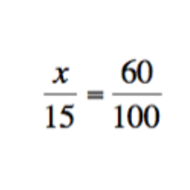
Kids that only know how to cross multiply love to get exercises like this:
And they're probably even pretty comfortable with this:


But things might start to fall apart sometimes when students have to set up the proportions themselves in a situation not neatly laid out for them in "word problem" format.

Here are two such attempts that I used in my Algebra 1 class this past week. One is about troop reduction in Afghanistan, and the other is about "total percentage of weight loss" and trying to win the reality show The Biggest Loser.


WAYS TO MODIFY THESE PROBLEMS:
  1. You could increase the rigor in both of these problems if you did not initially give either of the numbers I hand out (8000 and 51%, respectively) and instead, had your students figure out what number would be relevant to finding a solution that would satisfy the problem. After deciding what information was needed and/or relevant, students could do a web search to find the information for themselves. 
  2. Have an extension question exploring these ratios in a different way.
    1. The Afghanistan troop numbers could be compared to Iraq or previous deployments this century in Afghanistan.
    2. The Biggest Loser problem could ask students to compare Jerry to other seasons to see if he would have won those years. You could have students set up "teams" of Biggest Loser contestants and find the proportions of weight loss necessary to defeat other fantasy teams from previous Biggest Loser seasons.

17 August 2014

Relationship or Rigor?


Does it have to be one or the other? Its hard to argue that both relationship and rigor are both necessary characteristics for a warm learning environment that breeds growth. I was talking to one of my colleagues last week who was debating how long she should hold off on doing "math" so she could start the year with better relationships. She was feeling a little stuck as far what to do on the second day of school after she had already introduced her procedures and met her students on the first day.

I told her to go ahead and begin "math" operations, but to engage the kids in a game or competition. She would still have time to get to know her students, but would also set a tone for class engagement.

I think her conundrum was part of a problem with which we sometimes see our role as teacher. We split our job into two separate roles as "instructor" and "mentor," so we view some of our work as drilling and filling kids with knowledge, and then other times as when we do "relationship." Relationship is only genuine if its an ongoing process. I think we've all had those students that during "work" time they drive us crazy, but during "relationship" time, you really enjoy. If you really value relationship building in your classroom, then everything you do should be an opportunity to build on those, not just at the "fun" times.

Here's a few posts I've written related to the subject:
“Never smile until 2nd quarter.” Ever heard this advice? You can be firm and set a good tone for the year without being cold and unemotional.

Understanding and accepting your students’ nature - http://mrcbaker.blogspot.com/2014/07/your-students-will-never-be-perfect-and.html

Goal-setting with your students allow you to get to know them better and share your own experiences.

Treat your students like “real” people by offering a mobile device charging station.

Have your students pace and lead your lesson - resist the temptation to get through a certain number of problems. Quality examples and practice over quantity.

Put your students in your word problems. Even fictional scenarios can gain a kernel of relevance if your students are part of the story.

Transparency in your grading is important for students and parents. Making your standards “kid-friendly” will help your students in goal-setting and reconceptualizing your standards for your students will help you understand them more, too.

17 January 2014

CCSS Math, Cognitive Verbs, and Rigor

The title of this 40 minute PD session, "CCSS Math", is admittedly vague, which is a hard sell for people choosing PD sessions to attend, but as a presenter its a bit of relief because I can choose to focus on what interests me.

We've been talking a lot about "rigor and relevance," so I wanted to highlight the connections between the action verbs in the Algebra 1 standards and the verbs in the DOK chart so we could at least see that if we're achieving one, we'll probably hit the other. Whenever possible, I will try to avoid heaping on "add-ons".


WEBSITES REFERENCED IN THIS TRAINING
Ferguson-Florissant CCSS Resources
ffsdccss.weebly.com

FFSD Curriculum and CCSS Intranet Resources (Use the login Kevin Voepel shared with you)
http://training.fergflor.k12.mo.us/Curriculum/

Illustrative Mathematics
www.illustrativemathematics.org

Next Network Gold Seal Lessons
http://www.nextnetwork.org/spn/article/ctop/Gold-Seal-Lessons

Inside Mathematics
www.insidemathematics.org

CCSS Cognitive Verbs
Teaching Cognitive Verbs

I KNOW the Common Core Standards, But... 3 Lesson Resource Sites to Use Next Week


Rigor. Relevance. Cognitive Verbs. Instructional Shifts. If your district is even remotely on the ball in preparing you and your students for Common Core implementation, you've heard these buzz words, and hopefully know some of what more will be expected of our students operationally.

But what does that LOOK like?  I think the number one question I hear whispered around me during Common Core training sessions has been pleas for examples of lessons integrating the standards.

Here are three lesson resource websites that are navigated according to math instructional and practice strands.


"Illustrative Mathematics provides guidance to states, assessment consortia, testing companies, and curriculum developers by illustrating the range and types of mathematical work that students experience in a faithful implementation of the Common Core State Standards, and by publishing other tools that support implementation of the standards."


"Gold Seal Lessons provide teachers model, proven lessons ranging from one day to three weeks that they can implement.

Each lesson is designed to teach to specific standards/benchmarks/objectives and centered around a highly motivating theme, activity, or project. Lessons are typically multidisciplinary and deal with real-world situations or problems. Additionally, Gold Seal Lessons should challenge students to learn and perform in a variety of different ways. They may be asked to research, write, compute, model, demonstrate, build, survey, or report in a variety of academic, technical, work, or community environments."


"Inside Mathematics is a professional resource for educators passionate about improving students' mathematics learning and performance. This site features classroom examples of innovative teaching methods and insights into student learning, tools for mathematics instruction that teachers can use immediately, and video tours of the ideas and materials on the site."


All three of these sites feature lessons you could use in your classroom next week. The best way to begin implementing common core or anything new in your classroom is to start implementing common core in your classroom.

01 January 2014

The Daily 5 in Grades 6-12: Making It Work

This post is the 1st in a series devoted to adapting the literacy tenets of "The Daily 5" to a secondary classroom with 50 minute periods. You can catch the whole series here.


"A lot of these apps would be great for getting your Daily 5 work in..."

I was at an Education Technology Conference last February watching +Kathy Knutson and +Holly Camacaro present on their use of iOS apps in their Kindergarten and 3rd graders respectively, and Kathy paused for a moment to see if she needed to briefly summarize Daily 5 for anyone.

In the room full of elementary teachers, I was apparently the only one that raised my hand. No problem, I've got Google. A very easy search on Google for "daily 5" gets you to the "The Daily Cafe," where you find out that Daily 5 is a literacy framework with 5 tenets:
  1. Read to Self 
  2. Work on Writing 
  3. Read to Someone 
  4. Listen to Reading 
  5. Word Work 
Exploring even just the Daily 5 website, it quickly becomes clear it is written to elementary teachers with time in their day to go through extended centers - something not feasible for me in a 50 minute class period. Because I work with elementary teachers on the district EdTech Team, I filed it away as useful for perspective, but otherwise ignored it.

When we returned to school in August, we were told that one of the goals for the year was a strategic literacy initiative, and that our main tool would be called "Daily 5" - every student reading 5 minutes a day in every class. While that could look like one of the 5 tenets listed above, it felt like an irrelevant add-on to me, so using what I know from my elementary friends, I decided to take one of the 5 "centers" and choose to do ONE for that class period.

Focusing on ONE of the "Daily 5" for my 50 minute period instead of tacking a sustained reading time to the end or beginning of the period provides several instructional advantages:
  • I can integrate the literacy work into what I would be doing that day anyway 
  • I can do "Daily 5" during any point of the period. Some days it is my lesson starter, other times it is the meat of instruction, and still others, it serves as a summary/assessment reflection piece at the end of the period. 
  • Students see an integration of literacy in their math curriculum instead of just reading in their math class(room). 
  • I do not make a point to hit every "5" every week, but I usually get at least three, so students are exposed to diverse literacy activities beyond passive reading. 
  • Because literacy is not planned for as an add-on, its effects are more likely to endure and I am more likely to be persistent and consistent in its integration. 

I plan to go into more depth on my literacy and technology efforts as my own Daily 5 presentation with +Abby Erwin at this year's METC conference nears, but just to get you started, here are a few activities I use pretty regularly.

I keep a cheat-sheet taped to the chalkboard next to my desk for easy reference while I'm planning - feel free to print this one!

27 August 2013

Emergency Lesson Plans: AP Statistics

Someone came to the blog via this search a few days ago and found this post about my son's hospitalization as catalyst for my decision to finally MAKE emergency sub plans, but I'm sure they left disappointed, because I didn't actually share my plans in that post. :)


Principles for Emergency Planning
In the previous post about emergency sub plans, I laid out these principles I was going to follow as I crafted my plans:
  1. When choosing learning objectives, I'm going to focus on things we are currently addressing in our PLC Smart Goal, or critical skills that consistently need reinforcing. 
  2. Have a back up to the emergency plans in case students finish quickly
  3. Crowdsource your emergency plans with co-teachers.
  4. To give yourself ultimate flexibility (particularly in your emergency back-up), keep a class set or at least enough for 2 kids to share of your course textbook in a closet or cabinet nearby.
  5. Make it something you'll at least consider grading when you return.
Emergency Planning for AP Statistics
I have three thematic goals for my AP Stats students throughout the year: data gathering, data crunching, and technical writing, so all of the options listed here, so if I stick to those goals (principle #1), I'll have something that can be mostly applicable for students no matter where we are in the curriculum.
  • AP Practice Exam: The College Board releases items from old exams on their website. Might as well take advantage.
    • 1997 Released Practice Having students complete this all in one hour would be an impossibility, so you've got at LEAST two days of material here. I would have students work in pairs on either the multiple choice or free response and collaborate quietly.
    • Free AP Stats Practice Exam This test is secured behind your College Board Course Audit login, so be sure to have that info handy.
  • Data Collection/Experiments
    • "How Long Is a Minute" Materials and resources are usually intentionally scarce on guest teacher days, so its impractical to have plans that require elaborate handouts or materials list. This experiment is my current emergency plan, and I love it because its easily approachable early in the year before we've done a TON of stats work, and only requires a clock in the classroom with seconds.
    • Probability Simulator TI 83/84 app + this handout The handout is actually for a more extensive project, so you'd have your students BEGIN the project on this day (and work on it periodically over a matter of days), or just have students complete a portion of the work.
  • Probability Based Gaming


31 May 2013

5 Reasons Why Teaching Summer School is Good for Professional Development

I'm beginning my 6th edition of summer school for my district on Monday. My first summer, before we had children and my wife was still working, summer school was a means to cut my teeth in my own real-life math classroom before the fall semester began and stuff got real. 

Teaching summer school is more of a financial requirement for our family now, but there are still several things I enjoy about the summer session that I think make me a better teacher.

1. "Do your worst."
If you can handle what summer school students have to throw at you, you'll probably be prepared for the worst you may see during the regular session. Some summer school students are highly motivated (which is what I expected of all of them before my first summer), and they are a delight, but most in my district come to me with one or several of the following: immaturity, frustration, anger, dejection, ambivalence, complacency. I jumped over a table last summer in the midst of what was looked to be a fight brewing. It was awesome.

2. Try new things.
The thinking on this is that for most of these kids, whatever traditional activities you or a colleague tried during the spring or fall were not successful strategies, so repackaging the regular curriculum into a shorter chunk is asking for boredom at best, and more failure at worst. I feel less pressure to have my lessons or activities go perfectly during the summer because classes are smaller and we meet longer, so its more feasible to clarify directions and completely change course if necessary without sacrificing an entire day's 50 minute period.

I love piloting projects, games, and software in the summer.

3. Motivate, motivate, motivate.
This is for my students, too, but secretly maybe for me the most. :)
There aren't a ton of self-starting, goal-setting 16 and 17 year olds to begin with - you're definitely not going to find them in summer school. Teaching my summer students forces me to rethink why I teach, and what heights are possible for any of these students. 

Morning-grump-Chuck does not fly in summer session.

4. Make new connections with colleagues
Since my district consolidated summer school for our 3 high schools into one building 3 years ago, summer school has meant working more closely with teachers I only see on sporadic district PD days. Collaborating with these teachers during the summer has given me a clearer picture of what goes on across my district and helps me make sense of goals and vision given to us from administration across the street. Most of the trainings on this page were made possible by connections I made during summer school.

5. Prioritize and dump.
You know that practice where you teach some things during the regular school year "for exposure," just because its in your book, or you like that trick? 

Reteaching an entire semester's worth of content is obviously impossible, so the summer session requires refinement of the curriculum to essential topics and strategies. Fortunately for me, my district already has separate pacing guides for the summer, so I don't have to reinvent the wheel every summer.

This year, to cut costs, our district is holding only "credit recovery" courses, which the state allows for students who were close to passing. My class will be 2 weeks instead of the usual 4, so I'm forced to prioritize and predict where the biggest needs will be amongst my recovering students.

Why does this matter for the regular session? The topics we end up covering in summer school often become the subject of smart goals and data collection from common formative assessments in our PLCs.

30 April 2013

Tech Tip: Using Animation for Sharing Procedures And Directions


"Did you read the directions?"

"Yeah." 

"Alright. What's your question about them, then?"

"I don't get it."

"Which part?"

"I don't know."

How many times have you had a conversation like that? As you can tell from my gif there, conversations like that tend to bring out the grumpies in me.

It doesn't have to be that way!  Making quick videos and animations through services like Xtranormal or Go!Animate are an easy way to introduce assignments and projects or to draw your students into the lesson with something other than your (handsome) face.

Take, for instance, this area problem from my Applied Math book. I like it because it has elements of being open-ended, offers some choice for students, and secretly requires some scale factors and unit conversions.
If students don't read the paragraph on top, this is nearly impossible to do "right."
When my students did this problem 1st hour, I had several "I don't get it," questions - way more than I should have.

I knew part of the problem was that they didn't read the information above where #19 is, and some of it was my introduction of the problem (or lack thereof), so during passing time and our Do Now, I made this video on Xtranormal, essentially just copying most of the text from my book for the character to say. This literally took, about, 7 minutes. (And your students will be amazed.)

Pool Design Problem
by: chuckcbaker


A COUPLE OTHER EXAMPLES:
This one I made to introduce our study of minesweeper at Saturday School to improve reasoning
The Minesweeper
by: chuckcbaker


I set up an "interview" to address FAQs on a logarithms project
Functions Log Project FAQ
by: chuckcbaker


23 April 2013

Playing School: Be a Storyteller, Be Memorable (This Week's Exponential Functions)

There are two ways you can have you students write algebraic models for a set of points.

1. Give them step-by-step directions of abstract coordinates, master the steps, and then work on applying the new skills to word problems.

2. Give and define a structure (in this week's case, the exponential form), then lead them through stories, putting the pieces in place.

You may have more success with writing equations from a given graph if you follow the first method, but how connected will that learning be the logs lesson you're going to have in a few days? How applicable will that knowledge be (which is where you get to have some fun)?  Last Friday's quiz had several growth/decay questions, 3 graph to equation matchings, and then one equation modeling word problem that was really half of a context pieced around 2 chunks of data.

Results on the first section were great, but we fell off in the middle, and really lost it at the equation modeling. Last week's modeling examples and practice mostly consisted of a given set of points to be plugged into the general form to find a growth rate of initial value. Granted, we really only did it for a day, but I wouldn't say any memorable learning was going on.

This week, without anymore modeling instruction, I've seen more success (and certainly interest) in involving my students in the problems (that are still even mostly contrived).

Monday: Real basic information scenario-wise, but it gave us a reason to put in a value for y and solve for x..
"When will 1,000,000 St. Louisans be infected?"

Tuesday: Andre asked at the last second to be in the story, so, there he is. :) It actually helped with my setting when we did this problem the next hour.
Dani chose Taco Bell, which worked well with the radioactive mutation scenario here, LOL


Students are looking forward to the next day to see who gets to be in the story and how they are involved, and they're snapping pictures of the notes so they can think about it later.

You may remember two days ago when you worked through the example for exponential decay with points (0,9) and (5, .4), but  "The day Sam and her friends were the beginnings of an E. Coli outbreak" or "The day Dani ate the radioactive taco" is the kind of things remember (at the very least until next week.) :)

EXTENSION BONUS:
By modeling the process for writing and working through stories, you can segue way easily into students doing the same for their own assessments. #student-becomes-the-teacher

Student created assessments and demonstrating understanding through a story would be a great item to include in student portfolios if you and/or your school have student-led conferences.

30 March 2013

Emergency Sub Plans - Do You Have Any?

If you're 1:1, and you're doing it right, you shouldn't need emergency sub plans. Post a plan for your students on Edmodo, in Dropbox, their email, or in a Google Drive folder, and let the learning continue!

For everyone else less fortunate...

This is my 5th year teaching - of the 5 years, I've had "emergency" sub plans (for days when you're out last minute and don't have the time or will to put anything together) for one of those years. Kind of.

Top 5 Reasons NOT To Have Emergency Sub Plans

  1. Unless you redo them once a month, the chances of them fitting well into the current week's learning objectives is probably pretty slim
  2. More courses = more emergency sub plans to prepare (unless you want ONE generic plan for every course, no matter if its Algebra 1 or AP Stats; see no. 1)
  3. Having prior plans prepared requires prior preparation
  4. You hate your co-workers and want to push your lesson-planning onto them
  5. You hate your students, and want to completely waste their time for that day(s).
The ONLY Reason You Should Need to Have Emergency Sub Plans


I've finally started to learn it this year - when you're taking time off for your family, you need to be WITH your family - mind and body. I was very fortunate that our spell in the hospital last night was during Spring Break. This ER visit turned overnight observation was very sudden, and had I had classes to prepare for, I would have either severely burdened my friends in the department or burdened my substitute with awful, short, boring lesson plans for my students.

So, I'm finally going to make emergency sub plans for each of my 3 preps. I'm going to adhere to these principles as I prepare readings and make photocopies. (If I were using one of my most trusted subs, I would have them breakout the iPad cart, but seeing as these are emergency plans, counting on your preferred sub would be ill-advised. Kill the trees.)

5 Principles For Emergency Sub-Plan Planning

1. When choosing learning objectives, I'm going to focus on things we are currently addressing in our PLC Smart Goal, or critical skills that consistently need reinforcing. For my Applied class, it would probably be problem-solving skills: setting up problems to find solutions. For Algebra 2, it would be either be solving polynomials, or something about equations of circles. I love circles, and never really get to teach them.

2. Have a back up to the emergency.
Whether it be a challenge problem that could be approached by any level of your students, or skills practice sheet for review, or a writing/enrichment activity (something I did last month was asking how many primes there were from 1 to 100. Easily Google-able to check, but I required factorized proof), I'm going to have a back-up to my emergency plans that the sub can give to any kid that finishes the "real" work

3. Crowdsource your emergency plans.
Do you and a friend (or a couple friends) teach the same course? Pool your resources and efforts, and collaborate to make common emergency sub plans for all of you to use. This strategy fits in great with principle 1.

4. To give yourself ultimate flexibility (particularly in your emergency back-up), keep a class set or at least enough for 2 kids to share of your course textbook in a closet or cabinet nearby.

5. Make it something you'll at least consider grading when you return.
The older your students are, the more skilled they are at detecting busy work. Be kind to your students (and your guest teacher) and chose an activity that may be interesting enough to look through even if the kids are pretty sure you won't be scoring, and will have students producing something that will be of some interest to look at when you return. 


Alright. Who's got my sub plans? 

20 March 2013

Give Your Students More Control (and Make Yourself the Hero)

How many times have you thought,  "Now would be a good time to bring a student up to the board to work out a problem and have some more students interact in forming a solution..." but hesitated, or refrained from following your instinct because you knew they weren't going to be able to get through it at nearly the pace you could yourself?

Wait. Is that the point?


A student-centered classroom is messier and crazier because that's how kids work. A student-centered lesson does not look perfectly sequenced and free of error because the students are in draft mode. If they had all the connections and outlines to make a perfect presentation, there'd be no need to cover it.

I've you've ever helped a toddler or small child with a life skill, I think you'll know what I'm talking about. I went to the store with my 3 year old on Sunday night and I enlisted her help in "the problem." (Putting groceries on the conveyor belt and them sacking them up at Aldi).

Spoiler alert: she couldn't do it alone. :)

But there were some things she could. She proudly hoisted those rice cakes onto the belt, and tried her darndest with the pineapples. When it came time to bag, I think it took her all of the time I was bagging everything else to put the two rice cakes into their own canvas bag. It obviously took time, but she was able to problem solve, engage in some productive struggle, and eventually worked it out.


Fast forward to my AP Stats class today. I have a student who has missed a ton of time recently because its music competition season in Missouri and he's been practicing/performing different places. He's the type of kid that never does any homework or extra practice, but manages to get by alright with what he picks up in class.

Obviously, this strategy is unsuccessful when you aren't in class. So, there was some very basic understanding and vocabulary that he was missing from like, 2 weeks ago. When "Ryan" asked if we could do an exercise from the book together at the board, I welcomed him on up. 

Here's how it went:
  1. Ryan picked a problem - the other students evaluated it as something we could handle or not.
  2. Ryan read aloud the paragraph introducing the exercise (I LOVE that there are no problems in my Stats series that practice skills out of context)
  3. Ryan begins to write given and inferred info on the SMARTboard - his classmates respectfully correct his use of vocab, and then have a good conversation amongst themselves about different aspects of the problem set-up - I pretend I'm not really listening.
  4. They come to a period of uncertainty that they cannot resolve about how to apply the test hypothesis to the normal distribution - once I can feel them starting to look to me for a clue, I give some reinforcement to what one student has already said, saving the day, and allowing them to continue.
Warning: Making yourself the hero is NOT about preventing your students from writing some "wrong" things, finishing the problem for them, or taking back control. It's subtle, but its about finding a way to use the words/ideas your students have already posited, and making a connection or affirming someone's hunch to redirect the class down the right path.

I think Ryan learned more today because we were at the students' pacing, not my own. I'm in consistent need of reminder that it doesn't matter how much we get through if (1) we're going to have to do most of it over again, and (2) students aren't learning because the pacing is inappropriate.

Better examples and discussions are far more effective than more examples and discussion.

18 March 2013

Adding Mystery and Intrigue to Your SMART Notebook Lessons: Boxes and Screen Shade

Which of these normal, everyday slides from a normal, everyday Notebook lesson grab more of your attention?
What's behind those squares?
You can take the content you already have created in SMART Notebook (or PowerPoint for that matter) and up the interactivity of your lesson in a matter of seconds. By using the Screen Shade or boxes to cover text, images, or writing, you give opportunities for students to:

Predict...
  • what's next in a story
  • the next step in a mathematical solution
  • connections between two ideas
  • meaning of new words in context
Signal importance - I feel like my students skim over or miss even the bold words in texts, sometime, so I like that some books highlight, but you can even go the next step and emphasis with a box. 

Focus - When I'm hoping that I say the right words to communicate a concept to a student in the 30 seconds I have their attention, the LAST thing I want is for them to be focusing on something ELSE related to the lesson on the SMARTboard.

The greatest ally to misunderstanding in math class is misinformation. 
"You wrote it on the board, and you said..."
"Yes, but not at the same time..."
Encourage interactivity - that kid may not want to write a lick of the information you're sharing, but you better believe you may entice them with a chance to drag a box.

Now you've got, "Remember when you went to the SMARTboard and moved the boxes? That's what you need to use right now," in your back pocket, even though its surely no where on a piece of paper. :)


HOW TO...
Screen Shade:
Between boxes or Screen Shade, the easiest of the two to implement would be the shade. Pull up your content, put up the shade, and drag to reveal. I use this most often in my Algebra class to ask, "What do you think I did next?"
The Screen Shade icon
Drag at your own speed...
Boxes
Using boxes is a bit more complicated, but FAR more customizable. Here I've used boxes to cover up the solution to an example I grabbed from my online texbook using the screen capture tool (the camera icon)