Showing posts with label algebra 1. Show all posts

17 August 2023

How to: Import McGraw Hill eAssessment Assessments into your Canvas LMS

*This post was originally published in 2020 and updated in Aug 2023 to reflect a change in the click-flow on the McGraw-Hill platform*

This one is for my math homies in my school and out there in the #mtbos!

I've been teaching in Canvas for only a week, and I've already learned out two very important lessons: 

  1. Canvas has a LOT to offer as far as tools to deliver content to my students
  2. The more I keep my kids ON Canvas, the less confusing the flow of my class will be (which is super important for keeping you, kids, and parents all on the same page!)
So, as a part of my into-the-fire professional learning, I wanted to figure out very quickly if I could import assessments from our McGraw-Hill tools into Canvas to make building my curriculum muuuuuch easier. 

Here's how I did it:
  1. Create your assessment in eAssessment on the McGraw-Hill website
  2. Go to File --> Export --> QTI Standard --> QTI 2.1 and save the .zip file it creates.
  3. Go to File --> Export -->  QTI for Canvas --> New Quizzes and Item Banks (Updated since 2020 when I made this screencast!)
  4. Go to Canvas and click on the quizzes page or a module to create a new quiz. 
  5. Set the title and due date for your Canvas quiz
  6. Click on the 3 dots menu in the top right and choose "import content"
  7. Drag or navigate to the folder with your saved .zip file and upload.
  8. You're done! Go on over to the quiz settings and tweak how it best fits into your class.

14 April 2015

Tip Tuesday - Copy Your Padlets for Other Sections

I love using Padlet as a landing strip for students to share ideas, work, or problems they're creating.

Here's some ways I've used Padlet on my class set of iPads:

  • backchannel
  • students' summary statements after reading a text
  • generating questions before or after reading
  • gathering guesses or estimations of an answer during Act 1 of 3 Act Story
  • students creating/solving exercises to share with each other
  • reflecting on a video or text

Some of those uses listed above might actually be enriched by students being able to go back to earlier periods in the day and see what they did, particularly the backchannel or creating exercises for each other to solve. For the reflections or checks for understanding, I think having other kids' thoughts on there pollutes the experience and prevents new ideas.

For yesterday's work, I wanted my students to make up the graph of a line, write the equation for that line, share their work on the padlet, write the equations of some of their classmates lines, and then have the classmate check them off as correct or needing more work. It wouldn't have been the end of the world if some of the lines got repeated, but it was important that the line creators were in the room so that they could check their peers' work.

In THAT case, where you need a fresh board for each period, you can COPY your padlet with identical settings so that you don't have to duplicate your own work.


I chose "copy with posts" on this occasion because I wanted my own example up there. 


 Another pro tip: edit the addresses of your padlets for easy sharing with the date and hour.

After the day was over, I had 3 padlets that all looked SIMILAR, but were unique to each hour.


For more info, check out the Padlet blog - I checked after the fact, but they wrote a recent post about copying, too.   :)

11 October 2014

2 Exercises for "Relevant" Proportion Solving in Algebra 1

One of the first things I realized after becoming a math teacher in my very first Algebra 1 summer school course was that students love to cross multiply. You stick a fraction on the board and ask something like, "Okay, what next," and you will most certainly get some kids that are dying to cross multiply.

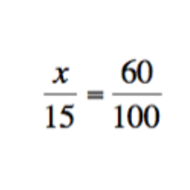
Kids that only know how to cross multiply love to get exercises like this:
And they're probably even pretty comfortable with this:


But things might start to fall apart sometimes when students have to set up the proportions themselves in a situation not neatly laid out for them in "word problem" format.

Here are two such attempts that I used in my Algebra 1 class this past week. One is about troop reduction in Afghanistan, and the other is about "total percentage of weight loss" and trying to win the reality show The Biggest Loser.


WAYS TO MODIFY THESE PROBLEMS:
  1. You could increase the rigor in both of these problems if you did not initially give either of the numbers I hand out (8000 and 51%, respectively) and instead, had your students figure out what number would be relevant to finding a solution that would satisfy the problem. After deciding what information was needed and/or relevant, students could do a web search to find the information for themselves. 
  2. Have an extension question exploring these ratios in a different way.
    1. The Afghanistan troop numbers could be compared to Iraq or previous deployments this century in Afghanistan.
    2. The Biggest Loser problem could ask students to compare Jerry to other seasons to see if he would have won those years. You could have students set up "teams" of Biggest Loser contestants and find the proportions of weight loss necessary to defeat other fantasy teams from previous Biggest Loser seasons.

01 November 2013

5 Questions for Every Standards Based Grader

I've dabbled with standards based grading in my high school math courses to varying degrees since January of 2010.


If you only read this far, allow me to share one piece of advice so you'll stop being scared, and just get started.

The only "right" way to do standards-based grading in your classroom is the way that is most fair to your students and gives you the best information about their learning. Most other variables will align with district policies, course structures, or personal preference.

Smart people like Robert Marzano and +Shawn Cornally would totally agree. I think. :)

That said, here is my guidance for implementing standards-based grading in your classroom.


Other Resources:

Standards-based Grading FAQ sheet (for students and parents)
Standards-based Grading Digest (weekly links, blogs, videos, articles)
PPT "syllabus" explaining my standards-based scoring
#sbgchat on Twitter (discussion, support, links)

06 September 2013

The Next Step: Re-wrapping Within Your Instructional Context

We had our fall open house last night, and during the "hour" my Algebra 1 parents were in the room, I was sharing with them my philosophy on graphing. Basically, that wherever, whenever possible, I want kids to use technology to make their graphs so that they can do all the state-standards-type activities: analyze slopes,  make predictions, relate what's going on in an equation and/or table to the behavior of the function.

I set a rule for myself last winter. "Never graph linear equations by hand." This was an easy line to draw in the curricular sand of Algebra 2 because the kinds (theoretically) already had a strong background in graphing linear equations, understanding that the coefficient of the variable was the slope, and how to articulate that between coordinate points.

Can I just as easily draw that line in Algebra 1? Do I believe as firmly in the value of conceptual understanding over procedure, or will I make the (perhaps) easier decision, teach a step-by-step process, and pass the conceptual buck on to the next teacher? (By the way, does anyone feel like the times you most often make instructional concessions against your better judgement for a student that the kid quite frequently ends up being in your class the next year)

So there I was, about to make a grand statement to parents about how their kids were never going to make graphs by hand, and I had to stop short. I literally stopped the sentence.
"I don't know," I said. "Its been a few years since I taught Algebra 1, so there are some things I'm trying to remember..."
"But, the content is easy, right?" a parent asked off to the side.
"Well, yes, but I have to conceptualize it differently between Algebra 2 and Algebra 1."
Is it wrong for there to be a difference, or must we always view our instruction within the context of our course/students' prior knowledge/school environment? Understanding when to re-contextualize that information and tailor it to those students in that year is what I've been learning about math instruction the last year. Lots of people can pick up math content. If content knowledge were most important, wouldn't a student ideally be able to teach an Algebra 1 course after they had mastered it?

The first time you teach a new course (or return to one you haven't had for a few years), there's a temptation to expect that once you reacquaint yourself with the content, that the rest of the year will work itself out. Of course a master teacher is a content expert, but even more importantly, they are adaptable and flexible to make instructional design decisions that they're willing to abandon if the delivery is not appropriate for their students' context.


06 February 2009

QUIZZES ON MONDAY, 2/9/09

The Geometry Quiz will cover lessons 8.4 and 8.5, Area of a Regular Polygon and Area of a Circle. Students will be able to use the formulas note organizer we made in class today on the colored paper.

Algebra 1's quiz is over Elimination by Addition and Subtraction and Elimination by Multiplication (5.3 and 5.4). Students will be able to use their Solving Systems note organizer we have been working on all chapter.

If you have any last minute questions this weekend, shoot Mr. Baker an email or post it to the forums! Good luck!